

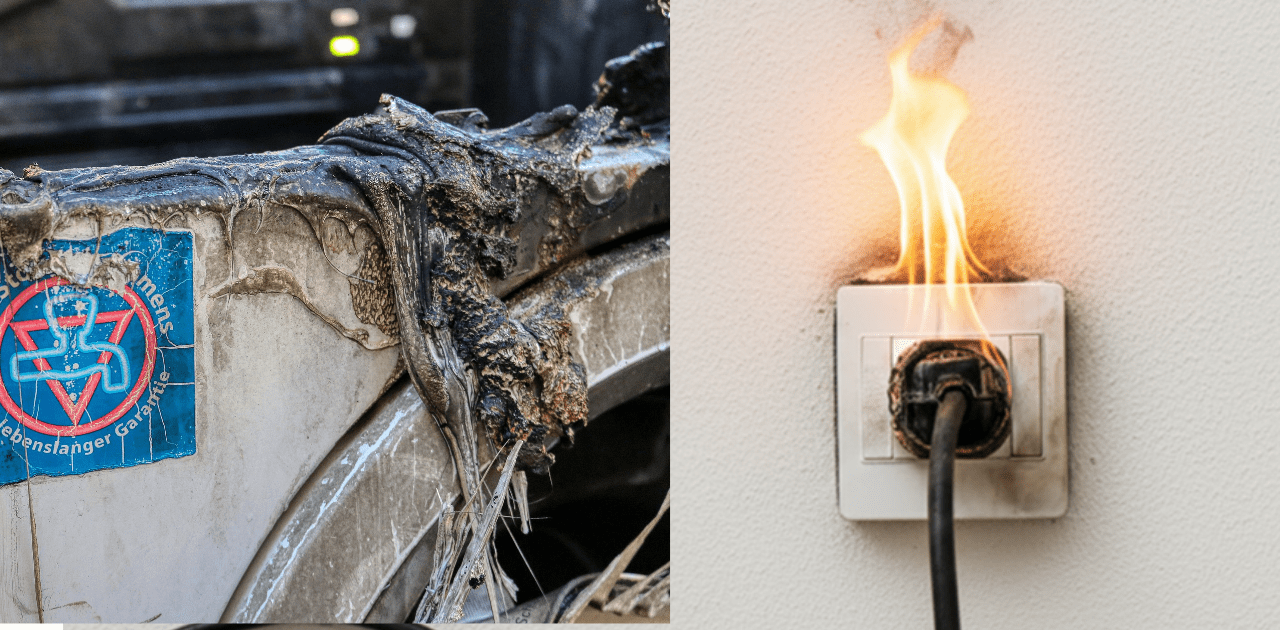
Most circuit breaker trips in homes, factories, or EV stati ons are caused by four issues: Ground Faults, Short Circuits, Overloads, and Over currents. They may look the same, a tripped breaker but the causes and fixes are different.
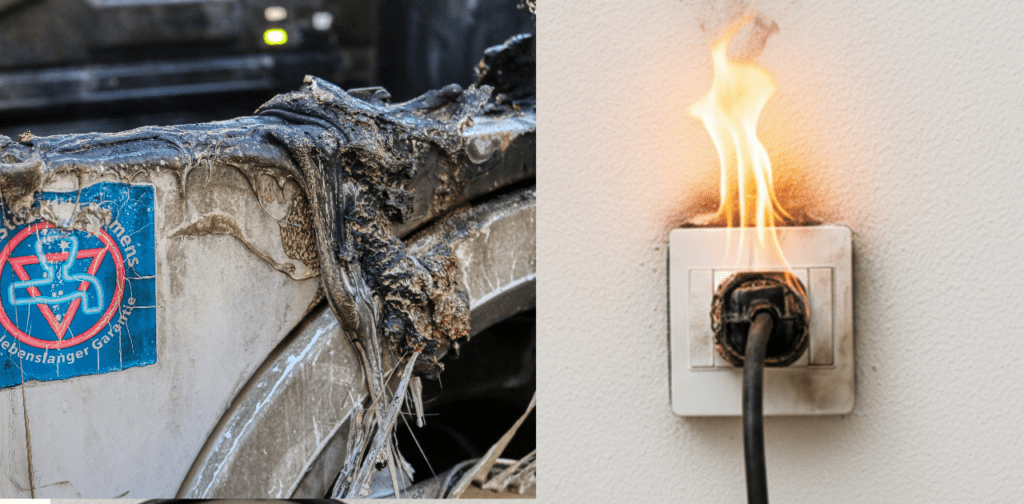
What Each Fault Type Really Means
Ground Fault
A GF occurs when electrical current strays from its intended conductor and flows directly to earth or a grounded surface instead of completing its circuit. This creates a risk of electric shock to people. For example, if a kitchen outlet protected by a ground fault circuit interrupter (GFCI) trips when water splashes, the device has detected a 5 mA imbalance between hot and neutral and disconnected power before current could reach you.
Short Circuit
A SC occurs when two conductors that should remain apart phase-to-neutral or phase-to-phase, touch directly. Current rises instantly thousands of times above normal.
Field tip:
After a SC, inspect insulation and terminals thoroughly, even if no damage is visible. Sometimes, heating weakens copper strands internally.
Overcurrent
Overcurrent means any electrical current above what the wiring or equipment is designed to handle. This includes SC, GF, and long-lasting OL.
For example, if a 15-amp motor suddenly draws 30 amps, that is overcurrent. Breakers or overcurrent protection relays act quickly to prevent equipment damage.
Overload
An OL is a slow, steady strain: a long‑term overcurrent due to too many devices or a jammed motor.
Field story: In a food–processing plant, a conveyor repeatedly tripped after ten minutes. Amp readings indicated the motor’s overload trip activated at 125% of rated current. Removing the jam resolved the issue with no motor replacement required.
Why Circuit Breakers Trip (And That’s a Good Thing)
A breaker protects your system, not annoys you. It trips in two ways: instantly for shorts or ground faults, and slowly for overloads.
- Thermal trip: slower reaction to an overload vs overcurrent condition.
If your breaker keeps tripping, it’s signaling a genuine issue, don’t override it.
Industrial and Residential Scenarios in the USA
Home Wiring
Bathrooms and kitchens are common sources of ground faults caused by damp cables or cracked insulation. That’s why ground fault protection system outlets are code‑required (NEC 210.8). Replace damaged cords; moisture + power equals disaster.
Motor Control Centers
Inside an MCC panel, jammed pumps or dusty conveyors trigger OL relays. Cleaning or torque‑checking terminals usually stops nuisance trips—no need for breaker changes.
EV Charging Stations
High‑voltage chargers rely on differential sensors; even slight leakage trips protection. Keeping connectors clean and dry prevents false electrical fault alarms.
Solar Arrays
Loose DC plugs or module cables resting on frames can cause SC that take down full strings. Proper cable tie spacing and conduit insulation are cheap insurance.
Comparison of Fault Types
| Parameter | Ground Fault | Short Circuit | Overcurrent | Overload |
|---|---|---|---|---|
| Current Path | To ground | Between conductors | Above rated level | Sustained above rating |
| Trip Speed | Instant (GFCI) | Instant (breaker) | Depends on fault | Delayed (thermal) |
| Main Device | GFCI / Ground Relay | Breaker / Fuse | Overcurrent protection relay | Overload relay |
| Common Cause | Moisture, damaged insulation | Wire contact, tool drop | Fault, extra demand | Mechanical stress |
| Risk | Shock hazard | Arc/fire hazard | Heating | Motor damage |
How Overcurrent Protection Works
Main Devices
| Device | Type | Working Principle | Typical Use |
|---|---|---|---|
| Fuse | Thermal | Element melts beyond rated current | Small circuits |
| Circuit Breaker | Thermal + Magnetic | Trips automatically | Homes & plants |
| Overload relay | Thermal / solid‑state | Monitors motor temperature | MCCs, pumps |
| Ground Fault Relay | Differential sensing | Detects current imbalance | Industrial systems |
Note for Technicians: Always coordinate protective devices with conductor ampacity and available fault current. Poor coordination multiplies downtime.
Troubleshooting and Safety Guidelines
Step‑by‑Step Fault Check
- Turn off and lock out the power.
- Look for burnt insulation or loose lugs.
- Verify proper ground fault protection system at outlets.
- Use a megger to test insulation > 1 MΩ hot‑to‑ground.
- Re‑energize with load monitoring; note abnormal amp draw.
- Confirm breaker‑to‑wire matching (80 % rule).
Key Safety Tips
- Never tape an always‑tripping breaker.
- Replace frayed cords immediately.
- Keep metallic enclosures solidly grounded.
- Wear full PPE during live troubleshooting.
Common Electrician Mistakes
Design Errors
- Oversized breakers are causing poor overcurrent protection.
- Mixing neutral and ground on sub‑panels.
- Ignoring the NEC derating for ambient temperature.
Maintenance Mistakes
- Bypassing OL relays during tests.
- Forgetting regular insulation checks.
- Allowing dirt and moisture to accumulate in cabinets.
Best Practices and Prevention
For USA Homes
- Use ground fault circuit interrupter (GFCI) outlets in wet zones.
- Add AFCI protection in sleeping areas.
- Keep the total continuous load ≤ 80 % of the breaker rating.
For Industrial Sites
- Use coordinated breakers (Type 2 per NEC 430.52).
- Train operators are to report any breaker that keeps tripping quickly.
- Log periodic torque checks and thermal scans.
Useful Tools
- Thermal cameras to spot overheating.
- Clamp meters for balanced phases.
- Ground testers to keep facility resistance below 5 Ω.
Overload Calculator
Formula:
% OL = [(Measured Current – Rated Current) ÷ Rated Current] × 100
Example:
Say a motor rated 20 A draws 25 A → [(25‑20)/20 × 100] = 25 % overload.
Motor Overload Calculator
Compute overload % from rated and measured current
Formula: ((Measured – Rated) / Rated) × 100
Real‑World U.S. Case Studies
Home HVAC Overload
A 2‑ton AC pulling more than rated amperage had a clogged filter. Cleaning reduced current from 27 A to 18 A, clearly an OL vs OC fix.
Conveyor Motor Trip
Industrial conveyor OL: belt jam raised torque, tripping OL relays. Mechanical, not electrical, correction solved it.
EV Charging Ground-Fault
Heavy rain caused a leak in a floor conduit; 7 mA of drain current tripped the ground-fault relay instantly. Resealing with watertight fittings resolved it.
Solar DC Short
Rubbing PV connectors caused arcing. Rerouting raised insulation resistance above 5 MΩ, eliminating the SC, causes an alert.
Quick Fault Reference Table
| Fault Type | Quick Sign | Likely Cause | Recommended Action |
|---|---|---|---|
| Ground fault | GFCI trips | Moisture, degraded insulation | Dry and replace conductors |
| Short circuit | Breaker trips instantly | Wires touching | Inspect and separate leads |
| Overcurrent | High amps under load | Undersized wiring | Match breaker & cable size |
| Overload | Gradual tripping | Extra load or drag | Reduce mechanical load |
FAQs – Explained for Technicians
What’s the difference between a short circuit and a ground fault?
A short circuit connects live conductors directly; a ground fault connects a live conductor to ground. One threatens equipment, the other threatens people.
Why does my breaker keep tripping if everything looks fine?
Recurring trips usually indicate OL vs OC or hidden moisture. Measure load current and check device insulation with a megger.
How can I differentiate Overload and Overcurrent fast?
If it trips after several minutes, it’s an OL; if it trips instantly, it’s a short circuit or sudden fault current surge.
How often should I test GFCIs?
Residential: monthly; Industrial: quarterly with injection test. Keep logs as per the OSHA electrical‑safety program.
Can repeating Overload cause shorts?
Yes. Continuous heat deteriorates insulation until it becomes conductive, turning small OL into full short circuit causes.
What is fault current, and why measure it?
Fault current is the instantaneous surge flowing at a fault event. It determines breaker interrupting capacity for the safe design of any MCC panel or service entrance.
Why must neutral and ground stay separate in sub‑panels?
Mixing them redirects current through the building steel, confuses ground-fault protection system sensors, and creates shock potential.
Why shouldn’t I oversize breakers?
Because it defeats overcurrent protection, letting conductors cook before tripping. Match breaker to ampacity per NEC 240.
Summary
SC (short circuit)
SC is what you get when two conductors that should stay apart end up touching or bridged by metal, carbon, or a loose strand. Current jumps almost instantly. In the field that shows up as loud trips, flash marks, or blown gear. Protection here is all about reacting fast enough to keep copper and steel from tearing themselves apart.
GF (ground fault)
GF happens when current takes a side path to metalwork or earth instead of staying on its intended return path. You’ll see it with wet conduits, damaged jackets, or nicked cords touching a frame. It’s less about saving hardware and more about keeping touch surfaces from going live, which is why GFCI and ground‑fault relays focus on it so much.
OL (OL condition)
OL is the slow, sneaky one. The circuit is carrying more amps than it was designed for, but not enough to trip right away. Think motors running tight, fans with blocked filters, or too many heaters on one run. Nothing explodes, it just runs hot. Over time insulation dries out, terminals loosen, and that quiet OL can set the stage for a later SC or GF.
OC (over‑current / OC)
OC is the big umbrella: any current above the intended level, whether it’s a brief inrush, an OL that builds up, or a full SC. Breakers and fuses are picked so they let normal service and inrush go by, but step in when OC reaches the point where conductors, terminations, or connected gear are at real risk.
Electrical protection isn’t luck; it’s learning to read what the amps are trying to tell you. Once you can spot the difference between SC, GF, OL, and OC in the real world, a “mystery trip” stops being a mystery and turns into a quick, methodical check.
On site, that means fewer callbacks, tighter panels, and gear that runs the way it was designed to run. For every U.S. tech, treating each trip as a message—not a nuisance, pays off in safety and uptime. Respect what the breaker is telling you; it’s your first, and sometimes only, line of defense.
