

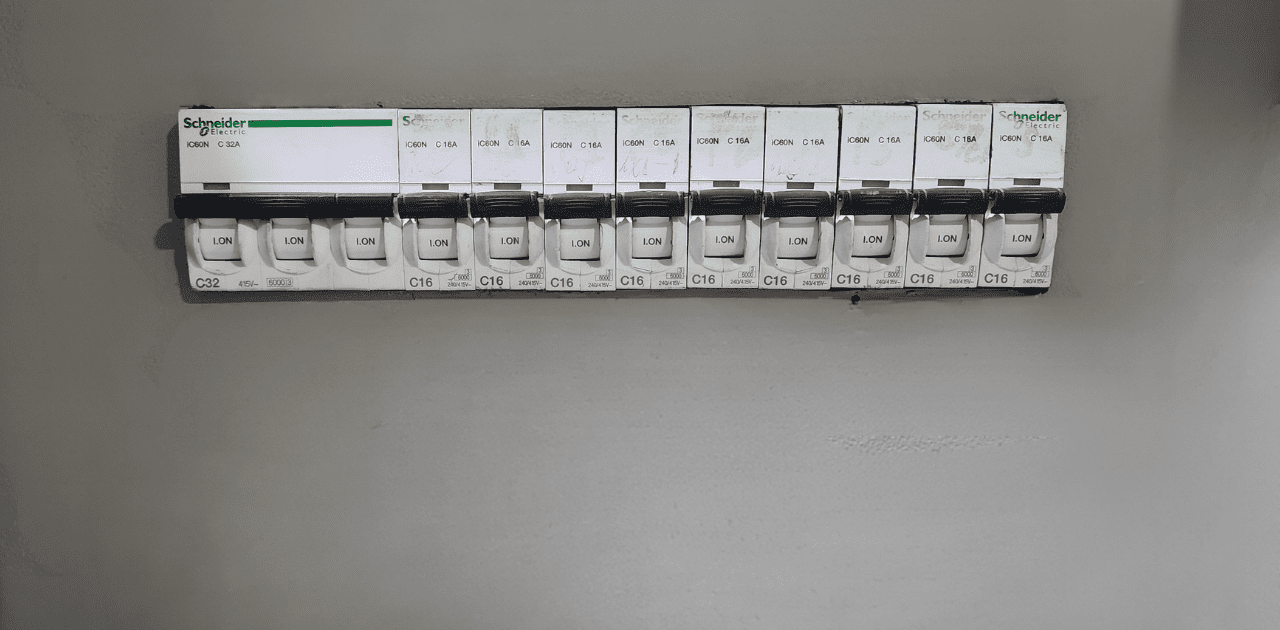
A circuit breaker protects the circuit during an overload, short circuit, or ground fault to save wires and equipment from potential harm.
Individuals employed in a plant, an electric vehicle (EV) station, or those engaged in simple wiring at home are always surrounded by circuit breakers. When they don’t, you lose production, you trip half a building, or you burn a set of motor windings that didn’t need to die.
From what I’ve seen over 20 years, most circuit breaker problems aren’t magic. They’re predictable, repeatable, and preventable if you understand how these devices really behave in the field.

Fig-1: Industrial circuit breaker lineup inside a motor control center protects feeders and large motors from overload and short circuits.
What Is a Circuit Breaker And Why It Matter?
In simple terms, a circuit breaker (CB) is an automatic switch that opens when current or fault conditions exceed the capacity of your conductors and equipment.
Compared to a fuse, a CB can be reset, adjusted (on larger frames), and coordinated with upstream and downstream protection. In US plants and homes, it’s the last line of defense against bad wiring and a fire report.
How a Circuit Breaker Works In Real US Systems
Normal operation
Under normal load, current flows through the CB contacts with minimal voltage drop. The frame, terminals, and bus are sized so the temperature rise stays within the UL and NEC limits for the ambient temperature.
Overload and short‑circuit trip
Inside a thermal‑magnetic CB, the thermal element responds to long, modest overloads (like a motor that’s slogging along at 130% FLA). The magnetic element reacts to high fault current in milliseconds.
- Overload: bimetal strip bends, unlatches the mechanism, and the breaker opens after a delay.
- Short circuit: magnetic coil pulls the latch almost instantly, clearing the fault before the fault energy welds your conductors.
What happens when a circuit breaker is tripped?
When a CB trips, three things happen in sequence:
- The internal latch releases, and the contacts separate.
- An arc forms and is forced into arc chutes, where it stretches and cools.
- The handle moves to the TRIP position between ON and OFF.
Out in the field, all you see is a handle that’s not fully ON or OFF, and a load that’s dead. Inside, the arc chamber probably just saved your panel from a fire.
Main Types of Circuit Breakers Used in the US
The 4 core types of CB you’ll see every day
Most US facilities use some mix of these four core CB types:
- Thermal‑magnetic branch CB (MCB style) in lighting and receptacle panels.
- Molded‑case CB (MCCB) for large motors and feeders.
- Ground‑fault protective CB (GFCI / RCCB style).
- Arc‑fault CB (AFCI) for dwelling units and some offices.
What is MCB and RCB / RCCB?
In plant and panel catalogs, you’ll see:
- MCB: Miniature circuit breaker, up to around 63 A. Used for branch circuits, control panels, and small motors.
- RCB / RCCB / RCD: Residual current CB. It trips on leakage current (the difference between phase and neutral), typically 30 mA or 100 mA, to protect people from shock.
In US residential work, the RCB function is mostly called a GFCI breaker. It’s the same safety idea with slightly different naming and standards.
GFCI and AFCI breakers in homes and small facilities
- GFCI CB: Trips on ground fault current to protect people, required for bathrooms, kitchens, garages, outdoors, and EV branch circuits.
- AFCI CB: Senses arcing patterns in the current waveform. Required for many dwelling unit circuits under NEC 210.12.
If you troubleshoot nuisance trips in homes, these smart CB are usually where the story starts.
How to Size a Circuit Breaker The Smart Way
You don’t need three pages of math. For most branch circuits in the US, I teach junior engineers one simple rule:
Simple sizing rule and example loads
For a continuous load (3 hours or more), size the circuit breaker at 125% of the load current, then pick the next standard breaker rating.
Basic rule:
Breaker amperes ≈ Load watts ÷ Voltage × 1.25
You still must check conductor ampacity and equipment nameplates, but this gets you in the right ballpark quickly.
| Load / Appliance | Typical Watts | Voltage (V) | Calculated Current (A) | Recommended Circuit Breaker |
|---|---|---|---|---|
| General receptacle circuit | 1800 | 120 V | 15 | 20 A branch breaker |
| Electric water heater | 4500 | 240 V | 18.75 | 25–30 A |
| Electric dryer | 5000 | 240 V | 20.8 | 30 A |
| Level‑2 EV charger | 7200 | 240 V | 30 | 40 A |
| 5 hp 480 V motor | ~7 A (FLA) | 480 V | — | 15 A motor circuit breaker |
| 3‑ton residential AC | 3500–4500 | 240 V | 18–23 | 25–30 A |
For more precise work, pair this with your wire sizing and our internal tools, such as the Voltage Drop Calculator on Industrial Control Academy.
(Internal link suggestion: link “Voltage Drop Calculator” to https://industrialcontrolacademy.com/voltage-drop-calculator/.)
Why Circuit Breakers Trip And Don’t Reset
What causes a CB to trip and not reset?
A CB that trips and refuses to reset is usually telling you one of four things:
- There’s still a short or ground fault on the load side.
- The handle never went fully to OFF, so the internal mechanism didn’t reset.
- The breaker is overheated or mechanically worn and should be replaced.
- For GFCI/AFCI types, there’s real leakage or arcing that needs to be fixed, not bypassed.
If you have to lean on a CB handle to keep it ON, stop. That’s not “holding it in.” That’s defeating protection.
How many times can a circuit breaker be reset?
Manufacturers test a CB for hundreds to thousands of mechanical operations, but not hundreds of fault trips. In practice:
- A few nuisance trips in a year are normal.
- A CB that trips daily under load indicates either the load is wrong or the breaker is damaged.
- After a severe short‑circuit event, I usually recommend replacing that CB, even if it appears to reset.
How Do I Reset a Circuit Breaker Safely?
Step‑by‑step, here’s how I teach apprentices to reset a CB:
- Identify the tripped breaker: handle between ON and OFF.
- Turn the CB to OFF and hold it there until you feel the latch reset.
- Reduce or unplug the load if possible (heaters, space heaters, EV chargers).
- Turn the CB back to ON with one smooth motion while standing to the side of the panel, eyes away from the arc flash line of fire.
- If it trips again immediately, stop and troubleshoot. Don’t keep flipping it.
For industrial gear and MCCs, follow your site’s LOTO and arc‑flash PPE rules before you touch a feeder CB.
Common Circuit Breaker Mistakes I See In US Plants And Homes
From houses to fertilizer plants, I keep seeing the same CB mistakes:
- Oversizing a CB to “stop nuisance tripping” instead of fixing the load or wiring.
- Double‑lugging two wires on one breaker terminal that’s only listed for one conductor.
- Packing outdoor panels so tightly that breakers run above their temperature rating in the summer sun.
- Ignoring torque specs leads to hot spots and mystery trips.
Here’s a quick field reference.
| Symptom | Likely Cause | Quick Fix |
|---|---|---|
| Breaker trips when big motor starts | Inrush current exceeds trip curve | Use D‑curve circuit breaker or install soft‑start device |
| Breaker hot to the touch | Loose lugs, high ambient, or overload | Re‑torque connections, improve cooling, and check load |
| Lights dim before breaker trips | Undersized feeder or voltage drop | Upsize wire / feeder, use voltage‑drop calculator |
| GFCI breaker trips randomly outdoors | Moisture in boxes or long cable runs | Dry and re‑seal boxes, shorten runs, use weather‑resistant (WR) devices |
| Breaker won’t reset even with no load | Internal damage or severe past fault | Replace the circuit breaker |
Troubleshooting: How Do You Solve a Circuit Breaker Problem?
Step‑by‑step checks with a meter
When a CB keeps tripping, my typical sequence in the field is:
- Verify rating: Is the CB sized correctly for the load and conductor?
- Measure load current: Clamp meter on each pole with normal operation.
- Insulation test: If there’s any hint of a short, use a megger on the cables and motor windings and their rating).
- Check terminations: Look for discoloration, melted insulation, and loose lugs.
- For GFCI / AFCI: Test with the built‑in test button, then isolate loads one by one.
When to call a licensed electrician
In US homes and small businesses, call a licensed electrician when:
- The main CB trips, and you don’t know why.
- You smell burning around the panel.
- You see arcing, buzzing, or visible damage on a breaker face.
- You’re not comfortable working at full energy, which is a very reasonable position.
In plants, follow your maintenance procedures and never defeat or bypass a CB for “production pressure.”
Real‑World Circuit Breaker Scenarios From The Field
EV charger tripping a 40A CB
I have seen many Level‑2 EV chargers on 40A CB in garages. On hot afternoons, ambient temperature inside a tight panel pushes the breaker past its thermal curve. Derating wasn’t considered.
Fix: Move the EV circuit to a cooler section, upsize the CB and conductors to 50 A per code and manufacturer data, and verify terminations.
Motor starter panel in a fertilizer plant
At one fertilizer plant, three 50 hp pumps were tied to a single 400 A MCCB. All three started at shift change. The MCCB’s instantaneous pickup was too low, so it tripped every Monday at 7:00 AM.
Fix: Adjust the trip curve, stagger starts in the PLC by a few seconds, and confirm short‑circuit ratings. No more Monday outages.
Data center UPS and main CB coordination
In a data center, a downstream UPS CB and the main service breaker tripped together during a fault in a PDU. Selective coordination hadn’t been modeled.
Fix: Use manufacturer time‑current curves, adjust settings so the downstream CB trips first, and re‑test with secondary injection where possible.
Home GFCI breaker nuisance trips
A GFCI CB in a US garage tripped whenever the homeowner ran a pressure washer and a freezer at the same time. The real issue was leakage current from long outdoor cords and moisture.
Fix: Replace worn cords, clean and dry outdoor boxes, and keep high‑leakage loads on separate GFCI‑protected CB.
Solar inverter back feed issue
On a small commercial solar roof, the inverter back feed a panel where the main CB was already at its bus rating. During high PV output and HVAC loading, the panel overheated.
Fix: Relocate the solar CB per NEC 705, reduce backfeed on that bus section, and verify bus and breaker ratings.
Practical Tips And Best Practices For US Engineers
A few habits will save you a lot of headaches with CB:
- Label every CB clearly so anyone on nights can find the right circuit without guesswork in bright daylight or under a phone flashlight.
- Use a torque screwdriver on every breaker lug; “hand‑tight” isn’t a spec.
- Keep panels dry and shaded where possible; high ambient kills CB life.
- For mobile troubleshooting, design labels and panel layouts that are readable on a small phone camera screen outdoors.
- For critical loads, take the time to coordinate upstream and downstream CB using manufacturer curves.
Where Circuit Breakers Matter Most Today
You’ll see CB doing the real work in:
- Power plants and refineries (MCCBs, LV and MV breakers protecting motors and transformers).
- EV charging stations (branch CB and GFCI protection for safety).
- PLC and control panels (small MCB CB protecting 24 V supplies and IO).
- Homes and apartments (AFCI / GFCI CB for life safety).
- Solar and battery systems (back feed and fault protection with selective coordination).
If you understand how a CB behaves in each of these environments, your designs and troubleshooting will go much more smoothly.
Quick Circuit Breaker Reference Tables
| Breaker Type | Typical Amp Range | Common Voltage Level | Typical Application |
|---|---|---|---|
| Miniature circuit breaker (MCB) | 6–63 A | 120/240 V | Branch circuits, control panels |
| Molded‑Case circuit breaker (MCCB) | 100–800 A+ | 208/480 V | Feeders, large motors, MCCs |
| GFCI circuit breaker | 15–50 A | 120/240 V | Bathrooms, garages, EV branch circuits |
| AFCI circuit breaker | 15–20 A | 120 V | Dwelling unit lighting / receptacles |
| Main service circuit breaker | 100–600 A | 120/240 V or 208/480 V | Service entrance, main panels |
Summary
A CB is a simple device on paper, but your plant or home depends on it every minute. When you size it right, mount it in a healthy environment, torque it correctly, and respect its trip signals, it’ll protect your conductors and equipment for decades.
From my own field work, the best engineers don’t “fight” CB They listen to them. A trip, a hot spot, a nuisance GFCI event – all of that is data. Use that data, fix the real cause, and your systems will run cleaner, safer, and with a lot fewer midnight call‑outs.
FAQs:
What is a circuit breaker?
A circuit breaker is an automatic switch that opens a circuit when current or a fault goes beyond safe limits. It protects wires, devices, and people from overheating, fire, and shock, and can be reset instead of replaced like a fuse.
What are the 4 types of circuit breakers?
The four types most US engineers deal with are miniature circuit breakers (MCB), molded‑case circuit breakers (MCCB), GFCI circuit breakers for ground‑fault protection, and AFCI circuit breakers for arc‑fault protection. Each targets a different kind of hazard.
What are RCB and MCB?
An MCB is a miniature circuit breaker used for branch circuits and small loads. An RCB (or RCCB/RCD) is a residual-current circuit breaker that trips when it detects leakage current to ground, primarily to protect people from shock.
How do I reset a circuit breaker?
First, move the circuit breaker handle fully to OFF, then back to ON in one firm motion. Stand to the side of the panel, reduce the load if you can, and if it trips again right away, stop and troubleshoot instead of repeated resets.
What happens when a breaker is tripped?
Inside the circuit breaker, the latching mechanism opens the contacts, an arc forms and is pushed into arc chutes, and the handle moves to a mid‑trip position. The circuit opens, stopping current before conductors or equipment overheat.
How do I get power back on after a breaker trip?
Unplug or shut off heavy loads, find the tripped circuit breaker, move it to OFF to reset the latch, then back to ON. If the breaker trips again, assume there’s a fault or overload and call a pro instead of forcing it.
What causes a circuit breaker to trip and not reset?
A circuit breaker that won’t reset usually has a persistent short or ground fault, a failed internal mechanism from a severe fault, or a handle that wasn’t fully turned OFF. On GFCI/AFCI breakers, ongoing leakage or arcing will also prevent a stable reset.
How many times can a circuit breaker be reset?
Mechanically, a circuit breaker can switch many times, but frequent fault trips shorten its life. A few trips a year are fine; a breaker that trips daily under normal use should be investigated and often replaced after the root cause is repaired.
How do you solve a circuit breaker problem?
Start by checking the breaker rating against the load, then measure current with a clamp meter. Inspect terminations, test insulation if you suspect a short, and isolate loads one by one. Replace the circuit breaker if it stays hot, smells burnt, or fails a simple continuity test.
What causes a breaker to trip with no load?
Often, the “no load” isn’t really no load; there may be a hidden device still connected. Other causes are ground faults, moisture in boxes, damaged cable, or a failing circuit breaker that trips below its rating. Insulation testing helps sort this out.
How do I know if I have a bad circuit breaker?
Signs of a bad circuit breaker include a handle that’s loose or spongy, burn marks or odor, heat with normal load, or a breaker that trips well below its rating after other causes are ruled out. In those cases, replacement is the safe move.
Can a circuit breaker go bad over time?
Yes. Heat, high fault currents, corrosion, and mechanical wear all age a circuit breaker. In my experience, breakers older than 30–40 years in harsh environments are worth reviewing and often replacing during upgrades.
Is it safe to reset a breaker multiple times?
It’s fine to reset a circuit breaker once or twice if you know the load was briefly heavy, like a vacuum and toaster on one circuit. If it trips repeatedly, stop resetting and find the underlying problem, because each trip stresses the breaker and wiring.
Why does my breaker trip when I plug in my space heater?
Space heaters pull close to 12–14 A on a 15 A circuit breaker. Add a TV, lights, or another appliance, and you exceed the circuit’s safe rating. The breaker is doing its job to prevent overheated wiring.
What size breaker do I need for a 5 kW water heater?
At 240 V, a 5 kW heater draws about 20.8 A. Applying the 125% rule, you size the circuit breaker around 26 A, so a 25–30 A breaker with matching wire and nameplate ratings is standard in the US.
Can I replace a 15 A breaker with a 20 A breaker?
You must not increase a circuit breaker size unless the wiring and devices on that circuit are rated for the higher current. Upsizing a breaker on undersized conductors is a fire hazard and a common code violation.
Why does my GFCI breaker keep tripping?
GFCI circuit breakers trip on leakage to ground. Moisture in outdoor boxes, long cable runs, old appliances, or shared neutrals can all create enough leakage to trip. Dry things out, separate circuits, and replace suspect loads before blaming the GFCI.
How long do circuit breakers last?
In clean, cool conditions, a circuit breaker can last 30–40 years or more. In hot, dirty, or corrosive environments, life is shorter. Routine IR scans and inspections are the best way to know when they’re getting tired.
How do I test a circuit breaker?
In the field, you can check a circuit breaker by verifying continuity when OFF/ON, measuring voltage drop under load, and using a clamp meter to see if it trips near its rating. Full calibration requires manufacturer test sets, which are usually performed by specialists.
Are AFCI breakers worth it?
For dwellings, AFCI circuit breakers are required by code in many areas and have caught real arcing faults, like damaged cords under beds. They can be fussy, but in my opinion they’re worth having when installed and wired correctly.
