
Power Line Transformer: How It Works, Voltages and kVA Ratings
Quick answer: A power line transformer, usually a pole-mounted distribution transformer, steps the medium voltage on overhead distribution lines down to the utilization voltage used by homes and businesses. In North America, a typical residential pole transformer takes a primary voltage such as 7,200 V and delivers a 120/240 V split-phase secondary.
This guide explains how these transformers work, what the common voltages and kVA ratings mean, how pole-mounted units differ from pad-mounted ones, why transformers fail, and what to do (and not do) if you see a problem. Ratings and examples are illustrative. Real equipment varies by utility, region and manufacturer.
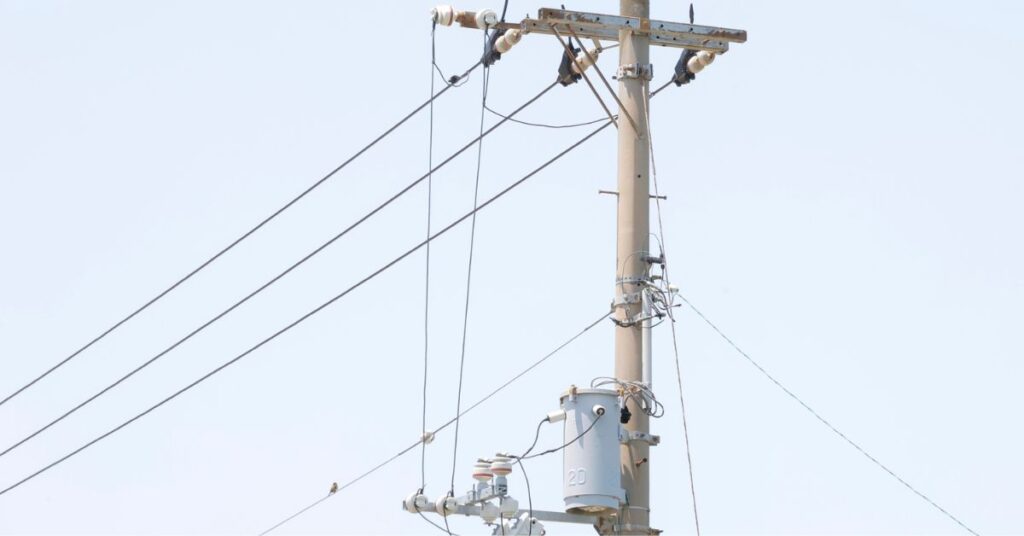
What Is a Power Line Transformer?
A power line transformer is a static electrical device that transfers energy between windings through a shared magnetic core, changing voltage and current levels without moving parts. On utility poles you will usually see a gray cylindrical tank. That is a distribution transformer mounted on a pole.
“Pole-mounted” describes where the transformer is installed, not a different operating principle. A pole-mounted transformer and a pad-mounted transformer work the same way. They differ in construction, mounting and application. For the wider category, see our guide to distribution transformers.
How a Power Line Transformer Works
A transformer has a primary winding (connected to the supply) and a secondary winding (connected to the load), both wound around a laminated steel core.
- Alternating current in the primary creates a changing magnetic flux in the core.
- That flux links the secondary winding and induces a voltage in it.
- The ratio of the voltages is set by the ratio of turns.
Turns ratio:
Vprimary / Vsecondary = Nprimary / NsecondaryA step-down transformer has fewer turns on the secondary than on the primary. That is what lowers the voltage.
Worked example: turns ratio
If 7,200 V is applied across the primary winding and the full secondary winding is intended to deliver 240 V:
Turns ratio = 7,200 / 240 = 30 : 1With a 33:1 ratio, the same 7,200 V primary would produce about 7,200 / 33 ≈ 218 V. That is mathematically correct, but it is not a nominal 240 V output, which is why real transformers are designed around the required secondary voltage.
Why current is higher on the secondary
Ignoring losses, power in roughly equals power out. For a 25 kVA single-phase unit:
Secondary current at 240 V  ≈ 25,000 / 240   ≈ 104.2 A
Primary current at 7,200 V  ≈ 25,000 / 7,200 ≈ 3.47 A
Higher voltage means lower current for the same power, which is why utilities distribute at medium voltage and step down close to the customer.
Primary and Secondary Voltages Explained
Primary side
Distribution voltages vary by utility. Two numbers often cause confusion:
- 7.2 kV is a typical line-to-neutral voltage.
- 12.47 kV is the corresponding line-to-line voltage on a three-phase wye system (12.47 kV ÷ √3 ≈ 7.2 kV).
A single-phase pole transformer is often connected line-to-neutral, so its primary sees about 7.2 kV on a 12.47Y/7.2 kV system. Other systems use other voltages, so always identify the actual winding connection and the utility’s system voltage rather than assuming.
Secondary side
120/240 V split-phase is the typical residential service in the United States. The secondary winding is center-tapped:
- Across the full winding: 240 V
- From either end to the center tap (the neutral): 120 V
208Y/120 V and 480Y/277 V are three-phase, four-wire wye secondary systems used in commercial and industrial buildings. They are not the default output of a typical single-phase residential pole transformer. Three-phase service is supplied by three single-phase units connected as a bank or by a single three-phase unit.
These are utilization voltages, not “safe” voltages. Even 120/240 V residential service is hazardous and can cause fatal electric shock.
Common kVA Ratings by Transformer Type
Transformers are rated in kVA (apparent power), not kW, because the rating is limited by voltage and current, not by the load’s power factor.
Standard rating ranges differ by transformer type, so they are listed separately below. These are illustrative examples. Available ratings, voltages and construction vary by manufacturer and utility, so confirm against the manufacturer’s published catalog or your utility’s specification.
| Transformer type | Commonly listed ratings (illustrative) | Typical application |
|---|---|---|
| Single-phase pole-mounted | About 10 to 167 kVA (for example 10, 15, 25, 37.5, 50, 75, 100, 167) | Residential and small commercial services |
| Three-phase pole-mounted | Roughly 75 to 500 kVA, depending on manufacturer | Commercial and small industrial loads on overhead lines |
| Pad-mounted (single-phase and three-phase) | Single-phase units in the tens to low hundreds of kVA; three-phase units from roughly 75 kVA up to the low thousands of kVA | Underground distribution, subdivisions, commercial and industrial sites |
How many customers a transformer serves depends on load, local practice and utility planning, not on a fixed household count.
Approximate full-load current (you can also use our kVA to amps calculator or 3-phase power calculator):
Single-phase:  I = (kVA × 1,000) / V
Three-phase:   I = (kVA × 1,000) / (√3 × V line-to-line)
The three-phase formula applies to a balanced load using line-to-line voltage.
What affects the right size
Do not use a single “oversize by 20 to 30%” rule. Utilities and engineers consider:
- Connected load and demand factor
- Diversity between customers (loads rarely peak at the same moment)
- Motor starting current
- Ambient temperature and loading cycle
- Expected future load growth
- The utility’s own planning and loading criteria
For a customer-owned transformer, a qualified engineer or the serving utility should size it.
Pole-Mounted vs Pad-Mounted Transformers
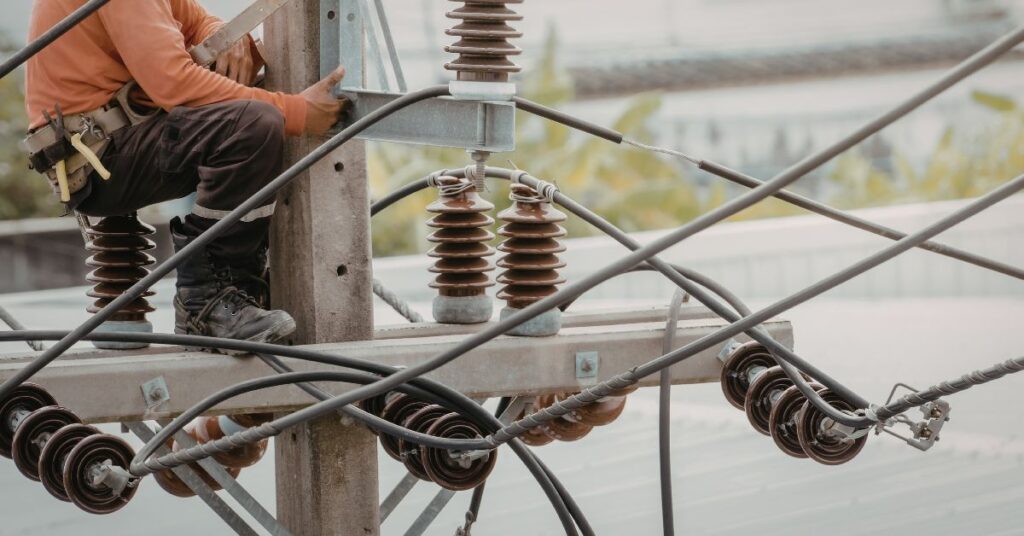
| Feature | Pole-mounted | Pad-mounted |
|---|---|---|
| Location | On an overhead utility pole | On a concrete pad at ground level |
| Typical supply | Overhead distribution lines | Underground distribution cables |
| Enclosure | Tank on the pole with exposed bushings | Locked, tamper-resistant cabinet enclosing the connections |
| Appearance | Gray tank visible on the pole | Green or similar box at ground level |
| Common settings | Rural and many suburban areas | Newer subdivisions, urban and commercial sites |
| Operating principle | Same | Same |
Both types are commonly liquid-filled distribution transformers. Neither is inherently “better.” The choice follows the utility’s distribution design.
Pole transformer vs distribution transformer
A distribution transformer is the category: a transformer that steps medium voltage down to utilization voltage near the customer. A pole transformer is a distribution transformer mounted on a pole. Pole-mounted describes the installation type, not a separate transformer principle.
This is different from a buck-boost transformer, which is a small transformer used to raise or lower a supply voltage by a modest amount. Higher-voltage substation equipment is covered in our guide to the power transformer.
What Is Transformer Oil For?
In liquid-filled units, the oil does two jobs:
- Insulation: it provides dielectric strength between the windings and the core.
- Cooling: it carries heat from the windings and core to the tank walls, where it dissipates.
Oil-filled and dry-type transformers each suit different applications. Dry-type units are often chosen indoors for fire-safety reasons. Do not assume that one type always lasts longer, is more efficient, or handles overload better than the other. Performance depends on the design, insulation system, loading and operating conditions.
Transformer Efficiency
Modern distribution transformers are generally highly efficient at rated conditions. Losses come from two sources: no-load (core) losses, present whenever the transformer is energized, and load (winding) losses, which rise with loading. Actual efficiency varies by size, design and loading. In the United States, minimum efficiency standards for distribution transformers are set by the Department of Energy. Check the current standards and manufacturer data for exact values rather than relying on a single generic figure.
Why Pole Transformers Fail
Typical causes of failure include:
- Lightning and switching surges, which can overstress insulation
- Sustained overload and overheating, including extra heating from harmonic-rich loads, which ages the insulation
- Insulation aging over many years of service
- Moisture ingress or oil contamination
- Loose or corroded connections, which can cause local heating
- External damage, such as vehicle impact, animals or falling trees
- Short circuits on the secondary side
Utilities monitor and maintain their equipment using manufacturer guidance and their own maintenance policies. Oil testing, including dissolved gas analysis (DGA), is used on some units. How often it is done depends on the transformer design, its condition and utility policy.
Safety: What to Do Around Power Line Transformers
Overhead distribution equipment carries medium voltage that can kill. Only qualified utility personnel working under approved procedures should inspect, test or repair energized utility transformers. For general guidance, see OSHA’s electrical safety resources.
If you notice a problem:
- Stay well clear of the pole, the equipment and any fallen lines. Treat every downed line as energized.
- Do not touch or approach a transformer, even if it looks damaged or dead.
- Do not try to test voltage, check fuses or use hot sticks on utility equipment. A non-contact voltage detector cannot prove that medium-voltage equipment is de-energized.
- Call your utility’s emergency number. If there is a fire, an injury or immediate danger, call emergency services.
- Signs worth reporting include leaking oil, unusually loud buzzing or humming, smoke or burning smells, arcing, a damaged pole, or lines on the ground.
There is no universal safe-distance number that fits every situation. Approach limits depend on voltage, equipment, applicable rules and qualified-worker procedures, so the safest rule for the public is to stay away and call the utility.
Problems on your side of the meter
If your lights flicker, the power is out, or voltages seem wrong, the cause may be on the utility side or inside your building. See why lights flicker for common in-building causes. Check your own main breaker and panel only if it is safe and within your qualifications, and contact the utility or a licensed electrician. Never attempt work on the utility’s equipment. For hazards inside a facility, see our arc flash study guide.
Why Distribution Transformers Matter Now
Transformers are critical to power delivery, and supply constraints have been widely reported. The U.S. Department of Energy has reported that demand for distribution transformers rose 41% between 2019 and the period it discussed, and that lead times grew from roughly three to six months in 2019 to one to two years or longer in 2024, the most recent year of data available in that DOE material. These are DOE-reported figures through 2024, not a current measurement.
Drivers include rising electricity consumption, aging equipment, storm restoration and supply chain limits. For anyone planning a project that needs a transformer, early coordination with the utility and manufacturers is important.
Frequently Asked Questions
What does a power line transformer do?
It steps down the medium voltage on distribution lines to the lower voltage used by homes and businesses.
How does a pole-mounted transformer work?
Alternating current in the primary winding creates a magnetic flux in the core, which induces a lower voltage in the secondary winding. The ratio of turns sets the voltage ratio.
What voltage comes out of a pole transformer?
In US residential service, typically 120/240 V split-phase. Commercial three-phase systems commonly use 208Y/120 V or 480Y/277 V, supplied by three-phase units or banks.
What is the primary voltage of a pole transformer?
It depends on the utility. A common example is 7.2 kV line-to-neutral on a 12.47 kV line-to-line system. Other voltages are used elsewhere.
Are pole transformers filled with oil?
Most are liquid-filled, commonly with mineral oil or other approved insulating fluids, which provide insulation and cooling.
How much does a pole transformer cost?
Prices vary widely with rating, design, efficiency level, market conditions and lead time. Request quotes from manufacturers or your utility instead of relying on a generic figure.
Can I repair or test a pole transformer myself?
No. Medium-voltage utility equipment must be worked on only by qualified personnel under approved procedures. If you see a problem, keep clear and call the utility.
What is the difference between a pole transformer and a distribution transformer?
A pole transformer is a distribution transformer mounted on a pole. “Distribution transformer” is the broader category.
Key Takeaways
- A power line transformer steps medium voltage down to utilization voltage near the customer.
- A step-down transformer has fewer secondary turns than primary turns.
- 7.2 kV and 12.47 kV are different conventions (line-to-neutral vs line-to-line) for the same type of system.
- Typical US residential service is 120/240 V split-phase. 208Y/120 V and 480Y/277 V are three-phase wye systems.
- kVA ranges depend on transformer type and manufacturer, so confirm against catalog data.
- Stay away from energized utility equipment and call the utility.
References and Further Reading
- U.S. Department of Energy: Distribution Transformer Convening Webinar transcript
- OSHA: Electrical safety
- Manufacturer product catalogs for distribution transformer ratings (for example, Howard Industries)
This article is for general education. It is not a substitute for utility procedures, applicable codes and standards, or advice from a qualified electrical professional.


