

Last summer my neighbor in the cul-de-sac had this backyard grill setup that looked sweet. String lights, little mini fridge, wet grass from the sprinklers, the whole deal. The outlet by the patio post was a GFI outlet. Or it was supposed to be. Nobody had tested it in months. Like, not once since they moved in.
His kid grabbed a wet extension cord end and touched the plug blades by accident while pushing it toward the receptacle. Zap. Not a movie lightning bolt, but enough to drop him and scare everybody silent. The GFCI never tripped. Not even a hiccup. That’s the part that sticks with you. A ground fault circuit interrupter that just sits there and lies.
So yeah, I get a little salty about this stuff. Why do people still have 80s wiring habits in houses that got flipped last year? Why do folks trust that one little Test button like it’s magic? A decent GFCI tester saves asses in wet spots. Bathrooms. Kitchens. Garages. Outdoors. Anywhere water shows up, and you’re barefoot or leaning on a metal sink.
And you don’t need to be an electrician to use one. You just need to not be reckless. Seriously, turn it off. If something feels wrong and you don’t know why, don’t play hero.
Quick side rant. Storms. I’m in Texas one week, Cali suburbs the next, and it’s always the same after a big blow. Garage door half stuck, puddles on the slab, homeowner says, “It was fine yesterday.” Sure it was. Water plus 120V AC doesn’t care what day it is.
Also code keeps tightening. NEC 2026 pushes more ground fault protection in places people used to ignore, and outdoor circuits feeding bigger loads keep getting attention. There’s talk and enforcement coming down around larger outdoor outlets, even up to 60A GFCI protection in some cases for certain equipment, and you’ll see more listed gear that wants protection built in. HVAC is its own headache. Variable speed inverter stuff can nuisance trip on plain GFCI, so you’ll hear about SPGFCI options, Class C style protection for certain loads, and listed solutions that try to stop dumb trips while still keeping people alive. I’ve seen installs where the old setup “worked” for years, then the new unit shows up and trips all day. People blame the new unit. Sometimes it’s the protection type. Sometimes it’s just sloppy wiring.
Anyway. If you’ve got downstream outlets tied to one GFCI and it fails quietly, all those outlets sit there unprotected. That’s how you get the patio kid incident. A GFCI tester is the cheap little truth teller.
What a GFCI tester actually does
A GFCI tester plugs into a North American 3-wire outlet and checks basic wiring first. Hot, neutral, ground. It uses LED indicators or an LCD display to tell you what it sees. Then it can simulate a ground fault by bleeding a small amount of current from hot to ground. That should trip the device if the GFCI is doing its job.
That’s it. It’s not magic. It’s a controlled “hey, are you awake”.
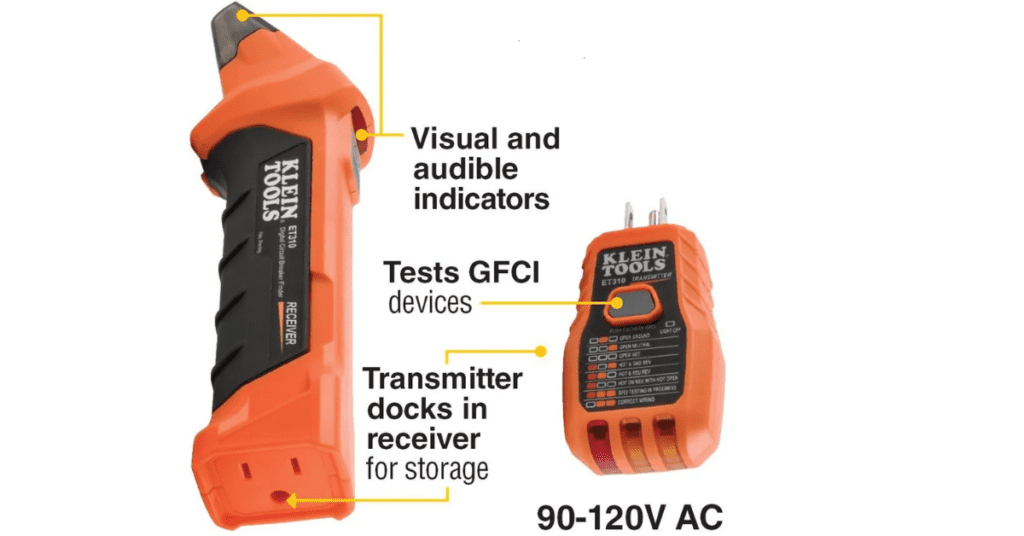
A basic GFCI outlet tester has a few lights. Usually two ambers for “correct.” Then different combos for open ground, open neutral, open hot, reversed polarity, and hot/ground reverse. Some of them add a red light or a beep. Simple. Fast. You can walk a house and check a bunch of outlets in minutes.
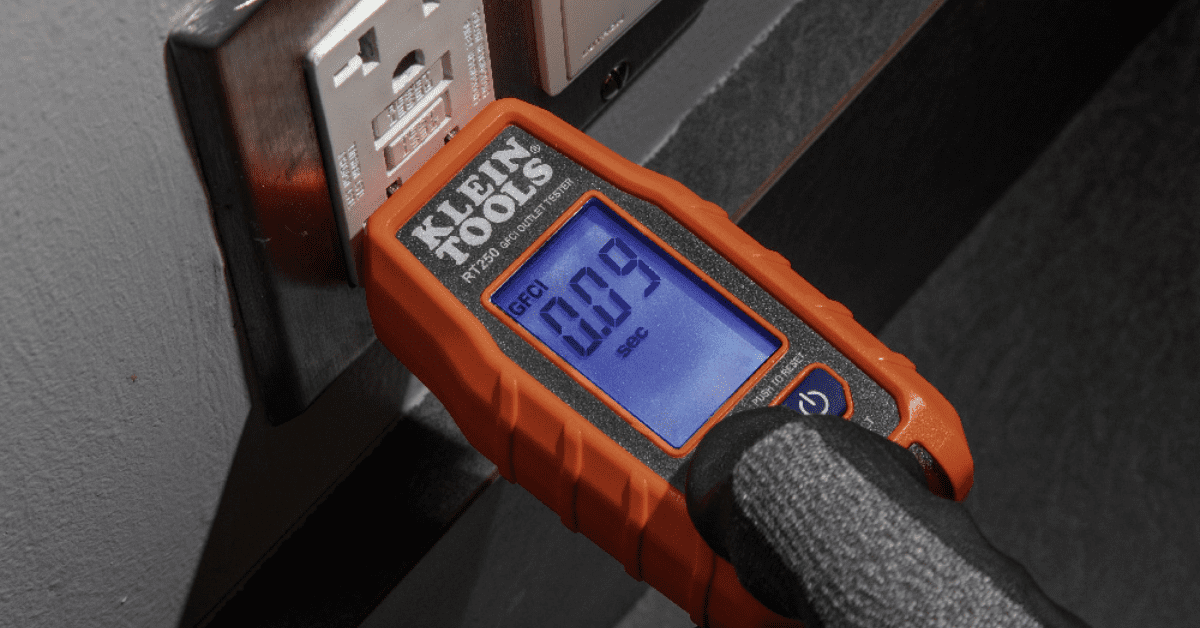
An LCD model, like the Klein Tools RT250, gives you more. It’ll show voltage, which is nice when you’re chasing a long run or a loose neutral. Some show trip time in seconds. That’s the part I like, because it tells you if the device trips fast or if it’s getting lazy. A ground fault tester that just says “it tripped” is fine for most folks, but the timer helps when you’re comparing outlets or dealing with a picky inspector.
Don’t confuse this with a multimeter. A meter does more, but it also lets you get yourself hurt quicker if you don’t know what you’re doing. A GFCI plug tester keeps you at arm’s length. Plug it in, read it, press a button. Less drama.
Also, some of these tools toss in extras. Non-contact voltage sensor. Little flashlight. I don’t hate it. But I don’t trust the cheap ones. I hate those no-name GFCI testers from overseas that falsely trip on clean circuits, then don’t trip when the GFCI is actually bad. They trip for no reason at all, then you waste time, and you start doubting everything.
So pick a known brand. Your time costs money. Even if it’s your own Saturday.
Why you’ve gotta test, even if the outlet “looks fine”
GFCIs fail Quietly. They don’t pop smoke. They don’t always stop working in a way you notice. The reset button can still click, the receptacle can still pass power, and the protection part can be dead. That’s the nightmare.
Code requires them in a bunch of spots. NEC 210.8 has been beating this drum for years. Bathrooms, kitchens, laundry areas, garages, basements, crawl spaces, outdoors, and other wet or damp locations. Job sites care too. OSHA rules push ground fault protection because people die on temporary power setups. And I’ve seen it. Cords in mud. Metal ladders. Somebody is barefoot because “it’s just for a minute.”
Aging is real. Heat cycles, lightning nearby, a surge from a storm, a loose neutral that arcs. All that can weaken a device. Then you get the day it matters. Then it doesn’t trip.
You don’t want that day.
Also, you might have multiple outlets downstream of one GFCI. People don’t realize it. They plug a freezer in the garage, it’s fed from the GFCI in the laundry room, and nobody tests that laundry device for three years. One failure and the whole chain loses protection. Checking the GFCI outlet protection means checking the whole path, not just the one you can see.
The wiring faults you’ll run into, and what the lights are trying to tell you
You’ll see “correct wiring” a lot. Great. Two amber lights are steady on many testers. On some it’s green. On some it’s two yellows. Don’t get locked into one chart; read the label.
Then you hit the fun stuff.
- Correct wiring, steady lights. Boring. Good.
- Open ground. This is the one that makes metal boxes bite you. You can still have power and still have danger.
- Open neutral. Things act haunted. Lights flicker, loads do weird junk, sometimes the tester shows a combo that makes you squint.
- Open hot. Dead outlet. No lights. People still try to “make it work” with adapters. Don’t.
- Reversed hot and neutral, reversed polarity. Some things still run, but you’ve got hot where you don’t want it. Lamps and old gear get sketchy.
- Hot/ground reverse. This one is nasty. It can make the ground path live. You touch a metal faceplate screw and learn a lesson.
- Hot on ground. I’ve seen it on DIY subpanels and on “my uncle wired it” garage circuits. Scary stuff.
LED meanings vary a bit. Some units show one amber plus red for a fault. Some blink. Some go dark on an open hot. And some cheap units lie. Yep, I said it.
Stick this in your head. If the tester says open ground, don’t shrug. That’s not a “later” problem in a garage or outside. That’s a “someone’s gonna get lit up” problem.
GFCI Tester
How to use a GFCI tester without doing something dumb
You can do this in a minute. Or you can mess it up and waste an hour. I’ll walk it like I’d tell a homeowner while I’m standing in a wet garage with my boots on.
First, look at the spot. Is the receptacle cracked. Is the cover plate broken. Is water dripping nearby. Are you standing on wet concrete in socks. Don’t laugh, people do it. Put shoes on.
Plug the gfci tester in. Firm push. Don’t wiggle it like you’re trying to start a lawnmower.
Now read the lights or the LCD. If you’ve got something like the Klein RT250, it’ll show voltage. You wanna see around 120V AC, give or take. If it’s 108V and you’ve got a heavy load running, maybe. If it’s 90V, something’s wrong. Loose neutral, bad splice, long run, or a backstab connection that’s hanging on by spite.
If the wiring lights show a fault, stop and think. Some faults can stop the test button from working right. A lot of plug testers need a real ground to create the fake fault. So if you’ve got an open ground, the trip test might not trip, not because the GFCI is bad, but because the tester can’t leak current to ground. That’s a common confusion.
Now the trip test. The gfci testing device will have a button. Press it. You should hear a click at the GFCI and the power should cut. If the outlet you’re testing is the GFCI receptacle itself, the lights on the tester go out. If you’re testing a downstream outlet protected by a GFCI upstream, the lights go out too, and you might have to hunt for the upstream GFCI to reset.
Trip time matters. Faster is better, within reason. Some LCD units show seconds. The RT250 can show trip time. A healthy device usually trips quick. If it takes a long beat, or it’s inconsistent, it’s telling you it’s tired.
Then reset. Press the Reset button on the GFCI outlet. Not on the tester. On the outlet. If it won’t reset, don’t keep jamming it like you’re mad at it. There could be no power, a line load mixup, or the device could be toast.
This is where I always think of a garage job from a few years back. Storm knocked a branch onto the service drop, lights flickered for a day, then “everything came back.” Homeowner calls because the garage outlets are dead. I find a GFCI behind a beer fridge, tripped. Reset won’t latch. Why. Because the line and load were flipped when someone replaced it, and it only sorta worked until it didn’t. I pulled it, rewired it right, tested it, it tripped clean. That dude had been running a table saw off an outlet that had no real protection path. Nice.
Built-in Test button vs tester button
The built-in Test button on a GFCI receptacle is good. Use it. But it doesn’t tell you everything about the actual trip behavior under a simulated leakage path through the receptacle. A GFCI receptacle tester hits it from the plug side. That’s closer to real life.
I like doing both. Press the device Test. Reset. Then plug in the tester and trip it. If either test feels off, I don’t trust that outlet.
Checking downstream outlets, the part most people skip
If your kitchen counter has six outlets and one GFCI at the first spot, test the first one. Then test the others too. You’d be shocked how often I find one outlet not actually protected because someone tied it wrong in a remodel.
So you plug the tester into a downstream outlet, hit the tester button, and see if power dies. If it doesn’t, that outlet might not be on the load side. Or the GFCI is dead and passing power without protection. Either way, not great.
This is checking GFCI outlet coverage, not just “does the one with buttons trip.”
Can you use it on regular outlets
Yep. A GFCI circuit tester still checks wiring on a normal receptacle. It’ll show open ground, reversed polarity, open neutral, all that. It just can’t trip a non-GFCI device because there isn’t one. So the test button won’t do anything useful there, other than sometimes dimming lights on junk testers.
If you want to find which outlets are protected by a given GFCI, the plug tester is actually handy. Plug it around and press test. When it kills power, you found the protected ones. Then you label them. People never label them. Drives me nuts.
Quick safety stuff, not the boring kind
If the outlet is buzzing, warm, or sparking, don’t test it. Shut the breaker off and call someone who knows what they’re touching.
If you’re outside and it’s wet, don’t kneel in the puddle to read the LCD like it’s a crossword puzzle. I’ve seen folks do this. Look man, don’t mess with this or you’ll regret it big time.
Using a multimeter, only if you really mean it
A meter can confirm hot to neutral voltage, hot to ground voltage, and neutral to ground. It can help you spot a bootleg ground. It can help you find a loose neutral. But meters are not beginner toys.
I carry one every day. I also carry scars. Not proud, just honest.
A gfci outlet tester gets you most of the way with less risk. If you need more, call a pro or at least get someone to show you in person.
Best GFCI Tester picks for 2026, the real ones I see people using
I’m not married to any brand. I’m married to tools that don’t waste my time.
Klein Tools RT250 is the LCD king right now. It shows voltage. It shows trip time. Reviews keep calling it best 2026, and yeah, I get why. It’s not cheap, but it’s the one I grab when I’m chasing a “sometimes it trips” complaint.
Fluke ST120+ is the one I trust when I need the beep. That beep matters in a loud house, or when you’re around a generator, or when a fan is screaming in your ear. Fluke tends to be boring and right, which is what you want.
Klein RT210 is basic. It does the job. No fancy readout. If you just want to know “wired right” and “does it trip,” it’s fine.
IDEAL 61-517 is solid. I’ve seen them survive drops. Good mid pick.
Southwire has a simple LCD budget option that’s honestly not bad for homeowners. Not as slick as the RT250, but it gets you voltage and a clearer read than the three-light units.
Milwaukee digital tester feels tough and the grip is nice when your hands are dirty. I’ve used one in a damp garage and it didn’t feel like it’d slip out and bounce into a puddle. That matters.
Harbor Freight Ames. Yeah, I know. Cheap. Works okay for DIY if you understand it might not be perfectly consistent. I’ve had one that read fine, and I’ve had one that acted weird on a clean circuit. That’s the gamble.
Sperry makes decent basic plug testers. Hubbell GFT2G shows up in some contractor bags too. Not flashy. Works.
Now the junk. No-name online kits with ten testers for twelve bucks. Nope. I’ve watched those false trip GFCIs and send homeowners into panic mode. Then I test with a real unit and everything is fine. Or the opposite. It says “correct” and the outlet has an open ground. That’s unforgivable.
Messy pros and cons table, like real life
| Klein Tools RT250 | LCD shows voltage and trip seconds, great for tracking weak devices | costs beer money, and you’ll cry if you lose it in insulation |
| Fluke ST120+ | beeper’s loud, feels reliable, pro vibe | price stings, and it’s not trying to be cute |
| Klein RT210 | simple, quick checks, toss it in a pouch | no trip timer, lights only |
| IDEAL 61-517 | durable | the light chart’s small, you squint in a dark hall |
| Southwire LCD budget | cheap-ish, readable | housing feels lighter, don’t stomp it |
| Milwaukee digital | tough grip, good in dirty hands | usually priced like it knows it’s red |
| Harbor Freight Ames | works okay DIY | you might get one that’s moody, like it woke up wrong |
| Hubbell GFT2G | contractor-grade feel | not as common on shelves |
| Sperry | basic and decent | nothing fancy, which is fine |
If you’re buying one tool and you want it to last, I’d pick RT250 or the Fluke ST120+. If you’re a homeowner who just wants to stop gambling with wet patios, a basic gfci plug tester from a known brand works.
Maintenance and when to replace a GFCI
Test monthly. Yeah, monthly. People hate that answer. Do it anyway. Tap the Test button on the outlet, then reset. Then use the gfci tester once in a while to verify the trip from the plug side.
If it won’t trip. Replace it.
If it trips but won’t reset. Replace it, after you confirm you’ve got power and the line and load are correct.
Trip current on most people-protection GFCIs is in that 4 to 6 mA range. The device should cut off fast. If the trip feels slow or it changes over time, don’t overthink it. Swap it with a UL listed unit. Especially in bathrooms, kitchens, outdoors, and garages. Those spots are where dumb mistakes happen. Wet hands, bare feet, metal sinks, concrete floors.
And don’t buy the sketchy stuff. I’m saying it again because I’ve seen the outcome. Seriously.
Random questions I hear all the time, so I’ll answer them like I’m still on the job
How often should you test. Monthly is the habit. If you use the outdoor outlets a lot, test more. After big storms too.
Can a multimeter replace a gfci outlet tester. Not really. A meter can’t easily simulate the ground fault trip the same way, and it takes more skill to use without doing something dumb.
What’s the best one right now. Klein Tools RT250 is my top pick for 2026 for most folks because the LCD and trip timer actually help, not gimmicks.
My GFCI won’t reset, what now. First check if it has power. Then check if it’s wired right, line and load. If you don’t know how, stop. Call someone. If it’s old or it feels crunchy, replace it. Don’t keep forcing it.
Difference between a normal receptacle tester and a gfci receptacle tester. The normal one checks wiring lights. The GFCI version also has the test button that should trip the device. That’s the whole point.
Wrap up, quick and plain about GFCI Tester
Water and power don’t mix. You already know that. But people still gamble with outlets outside, in bathrooms, in garages, all the places where you’re wet, tired, distracted.
Buy a decent GFCI tester. Use it. Label your protected outlets. Replace tired GFCIs with listed units. If you want one tool that’s hard to beat, grab the Klein Tools RT250 from a real supplier, Home Depot, Amazon, wherever you trust not to sell fakes.
And if anything about your wiring feels off, don’t poke it more. Kill the breaker and get help. I’ve seen what happens when folks “just try one more time.” It ain’t pretty.
Detailed GFCI Outlet Wiring Guide with 2026 NEC Updates Ground Fault Circuit Interrupter (GFCI)Common FAQ about GFCI TESTER
How do you use a GFCI outlet tester?
Plug it in and read the lights or the screen & Press the tester button, a good GFCI should click off quick and the outlet goes dead, then you hit reset on the GFCI.
How do you test if a GFCI outlet is working?
Plug in a lamp, so you can see it shut off. Then, Press TEST on the GFCI itself, the reset should pop and the lamp dies right away, if it doesn’t, replace the GFCI.
Will a GFCI tester work on regular outlets?
yes, it still checks the wiring on any 3-prong 120V receptacle, The test button just will not trip anything if there’s no GFCI upstream.
What do the lights mean on a GFCI tester?
Most show two amber lights for correct wiring. Different combos mean stuff like open ground, open neutral, open hot, reversed polarity, or hot ground reverse, use the chart printed on the tester body.
How often should you test GFCI outlets?
Once a month is a good routine since they can fail and still pass power. Test more in bathrooms, kitchens, garages, and outdoors, also after storms or nuisance trips.
Can you test GFCI with a multimeter?
You can check voltage and spot some wiring issues. but, it will not prove that the GFCI trips at the right point & right location. For that reason use the built-in TEST button or a plug-in GFCI tester.
What is the best GFCI tester in 2026?
Klein Tools RT250 is a favorite because it shows voltage and trip time in seconds. Fluke ST120+ is tough and the beep helps, IDEAL and Southwire are decent picks if you want cheaper.
How to troubleshoot a GFCI that won’t reset?
Unplug everything on that circuit first, one bad tool or wet load can hold it tripped. If it still won’t latch, check line and load wiring or just replace the device, they do wear out.
Difference between GFCI tester and regular outlet tester?
A regular outlet tester mostly tells you if the wiring is right or something issue with wiring. A GFCI tester also forces a trip, so you are checking the protections, not only just lights.
What happens if you use a GFCI tester on a non-GFCI outlet?
It will still show wiring faults like open ground or reversed polarity. The test button won’t do much since there’s nothing to trip, and some cheap testers may give odd results.
