

1. Introduction
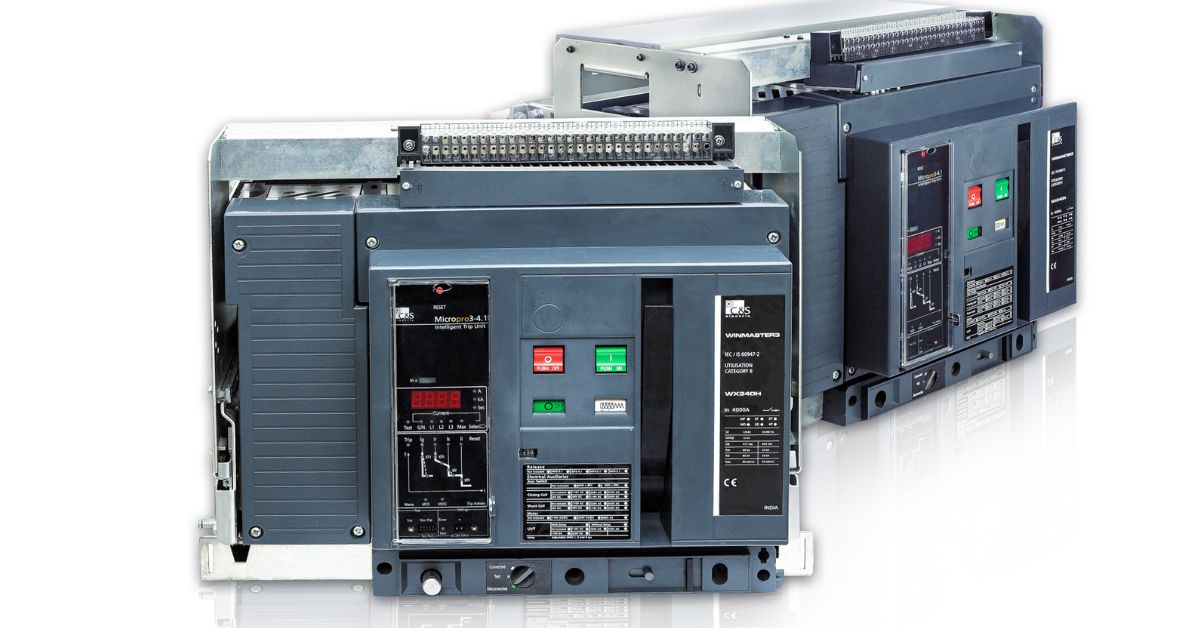
ACBs are used in the main switchboards of factories, malls, data centers, power plants, and large buildings. They protect transformers, generators, long busbars, and very expensive equipment from faults and fire. Older systems used oil circuit breakers, but oil can burn and leak, so modern low voltage systems moved to ACBs that use air as the insulating and arc quenching medium.
In this guide I will explain how an ACB works, its parts, different types, where to use it, its pros and cons, and how to maintain it safely. I will also mix in real stories from the field so it feels less like a textbook and more like learning from a senior colleague on site.
Table of Contents
2. How Does an Air Circuit Breaker Work
Think of a candle flame. If you blow on it strongly, stretch it, and cool it, it finally goes off. An ACB does something similar with the electric arc that appears when its contacts open.
Step by step working idea
- Normal operation
The ACB is closed. Current flows through its main contacts and busbars just like a normal switch, but it is designed to carry thousands of amperes continuously. - Fault detection
If there is a short circuit or overload, the current suddenly rises.- In a thermal magnetic breaker, a bimetal strip bends with heat for overloads and a magnetic element reacts instantly to very high short circuit current.
- In an electronic trip unit, current transformers measure the current and a microprocessor decides if the breaker must trip. (ABB Emax, Schneider MasterPact, Eaton IZMX all use such ETUs.)
- Trip signal
The trip unit sends energy to the trip coil. The coil pulls a latch, releasing the spring charged mechanism. This is like pulling the trigger on a loaded spring gun. - Contacts open and arc forms
The moving contacts separate from the fixed contacts. The voltage tries to keep the current flowing, so an arc forms between the contacts. This arc is a hot conductive plasma. If you looked inside at the wrong time, it would be like a tiny lightning bolt. - Arc control and extinction
The ACB is designed to force that arc into an arc chute made of many metal plates and insulating barriers. The arc is- Stretched so its length increases
- Split into smaller arcs between plates
- Cooled by the surrounding air and metal
This increases arc resistance and arc voltage so quickly that the current is forced to zero and the arc dies.
To help with this
- Magnetic blowout type designs use magnetic fields produced by the fault current to push the arc into the chute.
- Air blast types use high pressure air jets to blow the arc, more common in high voltage ACBs.
If you picture it, imagine two contacts pulling apart, a bright line forming between them, then that line being pulled upward into a box full of plates that chop and cool it until it disappears.
The whole process takes a few cycles of the AC waveform, typically under 50 ms, yet it safely clears tens of kiloamperes of fault current.
3. Construction and Main Components of ACB
Modern ACBs such as Schneider MasterPact MTZ, ABB Emax2, Eaton IZMX or Siemens 3WL have similar main parts even if the shapes differ.
Key elements
- Outer frame and enclosure
Strong steel or molded frame that holds everything and provides mechanical strength. In a drawout ACB, this frame slides into a cradle inside the switchboard. - Contacts
These are the current carrying elements. Usually there are- Main contacts for normal operation
- Arcing contacts that touch first and break last to protect the main contacts from arc damage
Contact tips use silver alloy or copper alloy for good conductivity and wear resistance.
- Arc chute or arc extinguisher
Stack of metal plates and ceramic or fiber insulators that guide and break the arc. This is the chimney for the electrical fire. - Operating mechanism
A spring charged or motor charged system that opens and closes the breaker. You will see- Manual charging handle or motor
- Closing coil
- Opening or trip coil
These must be strong and fast but also reliable for thousands of operations.
- Trip unit and releases
The brain of the ACB. Either- Thermal magnetic unit for basic protection
- Electronic trip unit that lets you set long time, short time, instantaneous, ground fault, and communication features.
There can also be shunt trip and undervoltage releases for remote or safety tripping.
- Current transformers and sensors
Measure the current flowing through each phase and feed the trip unit. Usually integrated into the breaker body. - Terminals, busbars and racking system
Heavy copper for connecting to switchboard busbars. In drawout ACBs there are racking screws and shutters that cover live parts when the breaker is withdrawn.
Here is a summary of major components.
| Component | Main Function | Common Materials | Maintenance Tip |
| Main contacts | Carry normal load current | Copper alloy, silver plating | Check for pitting or discoloration during outage |
| Arcing contacts | Take arc during opening and closing | Copper alloy | Replace when badly burnt, follow OEM limits |
| Arc chute | Cool and split the arc | Steel plates, ceramics | Clean dust, never file or modify plates |
| Operating mechanism | Open and close the contacts | Steel links, springs | Light lubrication, check for free movement |
| Trip unit | Sense fault and trip mechanism | Electronics, CTs | Keep dry, verify settings and firmware updates |
| Auxiliary contacts | Send status to control and interlocks | Silver plated small contacts | Test continuity during periodic maintenance |
| Terminals and busbars | Connect ACB to system conductors | Copper, aluminum | Tighten as per torque spec, look for heating |
| Drawout cradle parts | Allow safe insertion and removal | Steel frame, shutters | Test racking smoothly, confirm test and isolated positions |
From my experience, most mechanical failures come from lack of lubrication or dust in the mechanism, not from fancy electronics.
4. Types of Air Circuit Breakers
There are several ways to classify ACBs. One is based on how they deal with the arc, another by mounting style, and another by number of poles.
By arc control method
- Plain break ACB
Oldest type. Contacts simply separate in air with basic arc shields. Only for low fault levels, mostly history now in modern industrial systems. - Magnetic blowout ACB
Uses magnetic fields produced by coils around the contacts to push the arc into the arc chute. Very common in low voltage ACBs for up to around 100 kA breaking capacity, as shown in many Schneider and Eaton catalogues. - Air blast circuit breaker
Uses high pressure air from a compressor to blow out the arc. Used more in high voltage switchyards in the past, now often replaced by SF6 or vacuum breakers.
By mounting
- Fixed mounted ACB
Bolted into the switchboard. Smaller footprint and slightly cheaper, but harder to remove for maintenance. - Drawout or withdrawable ACB
Can be racked out into test or isolated position on rails. This lets you safely work on the breaker while the busbars remain live. Common for main incomers and tie breakers in large LV panels.
By number of poles
- 3 pole ACB
For three phase systems without neutral switching. - 4 pole ACB
Includes switching of neutral, used in systems where you need full isolation of neutral or protection on neutral.
Combined comparison of some common types.
| ACB Type | Typical Breaking Capacity | Best use case | Main Benefit | Main Drawback |
| Plain break | Low, under 20 kA | Small old installations | Simple, cheap | Poor arc control, obsolete design |
| Magnetic blowout, fixed | 36 to 100 kA | Feeders, generator breakers | Good performance, no compressor needed | Harder to remove for maintenance |
| Magnetic blowout, drawout | 50 to 150 kA | Main incomers, bus couplers | Easy maintenance, high capacity | Bigger size, higher cost |
| Air blast high voltage type | Very high at transmission level | Old HV substations | Fast arc clearing at high voltages | Needs compressor, complex system |
Most low voltage switchboards today use magnetic blowout ACBs with electronic trip units in drawout form for main sections.
5. Advantages and Disadvantages of Air Circuit Breakers
From both manufacturer data and what I have seen in real plants, ACBs have some clear strengths and some weaknesses.
Main advantages
- High breaking capacity, many modern ACBs at 415 V are rated 50 kA to 100 kA or more according to Schneider and ABB catalogues.
- Easy to inspect and service since the internal parts are accessible, especially for drawout types.
- Use air as arc medium, so no oil leaks or SF6 greenhouse gas.
- Wide adjustable protection settings with electronic trip units, including zone selective interlocking and communication.
- Long mechanical and electrical life if maintained properly.
Main disadvantages
- Larger physical size compared to MCCBs of similar current rating.
- Higher initial cost.
- Some high voltage air blast designs need compressors and air piping.
- For small loads they are overkill, and panel space becomes an issue in tight rooms.
Short summary table.
| Point | Advantage or disadvantage | Simple example |
| High interrupting rating | Advantage | Can clear a 65 kA fault at 415 V on a big transformer feeder |
| Large size | Disadvantage | One 3200 A ACB can occupy a whole vertical section of a panel |
| Adjustable settings | Advantage | Can set different trip curves for motor, transformer, or feeder |
| Needs skilled handling | Disadvantage | Wrong setting on ETU can cause nuisance tripping or no tripping |
6. Applications and Where ACBs Are Used
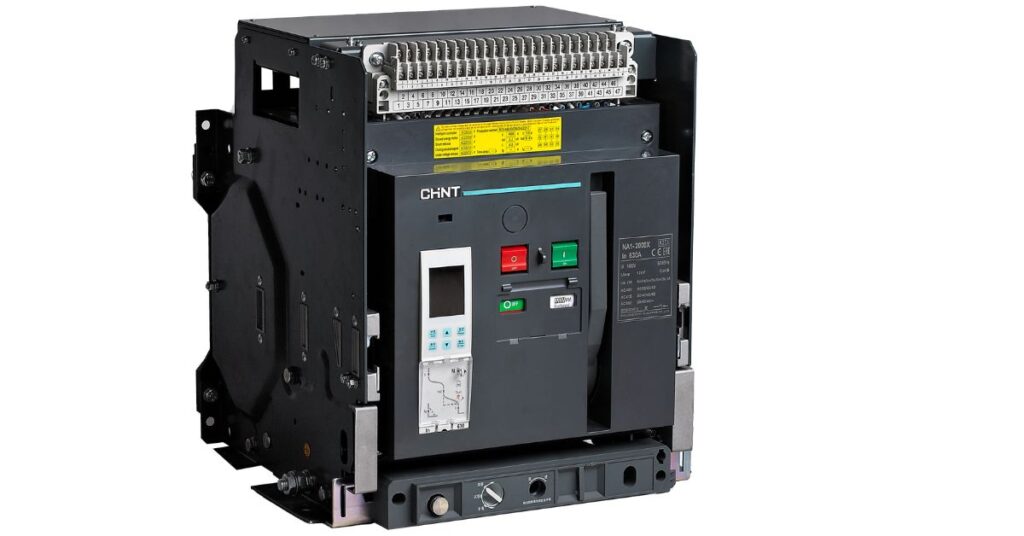
You normally use an ACB when the current is high, typically 800 A to 6300 A at low voltage, and when the fault level is high.
Typical applications
- Main incoming breaker in low voltage switchgear from transformer or generator.
- Bus tie breaker between two bus sections in an industrial plant.
- Generator output breaker in power plants or large backup generator systems.
- Main distribution boards in data centers, airports, and hospitals where reliability is critical.
- Protection of large motors, large UPS systems or big rectifiers when coordinated correctly.
Quick comparison in practice
- For small distribution boards up to 630 A or 800 A, MCCBs are usually enough.
- When the load or fault current grows, and you need drawout facility, zone selective interlocking or advanced metering, ACB is the better choice.
- For medium voltage above a few kV, vacuum circuit breakers or SF6 breakers take over.
In one cement plant I worked at in Punjab, the 2500 kVA transformers fed 3200 A ACBs as incomers, then outgoing feeders were a mix of MCCBs and motor starters. In a Dubai data center, all main and backup sources ran through 4000 A drawout ACBs with electronic trip units, because uptime and selective coordination were critical.
7. Maintenance and Troubleshooting Guide
An ACB can easily serve 20 years or more if you treat it well. Skip maintenance, and it can fail the day you need it most.
Safety rule before anything else
Always isolate, rack out if possible, lock and tag, test for absence of voltage, then start work. I have seen people get nasty burns by assuming a breaker was dead when it was not.
Why regular maintenance
- Prevent mechanical jamming during a fault.
- Avoid overheating at loose terminals.
- Keep arc chutes and insulation clean so they perform as tested.
- Catch early signs of wear or misadjusted trip units.
Typical maintenance checklist
- Visual inspection
Look for dust buildup, corrosion, oil or grease where it should not be, cracked insulation, deformed parts. - Cleaning
Use a vacuum and dry lint free cloth. Never blow moist air from your mouth, and avoid aggressive solvents on plastic. - Mechanical operation test
Open and close manually and electrically. The motion must be sharp, not sluggish. If you hear scraping or grinding, stop and investigate. - Contact condition check
On drawout ACBs, withdraw the breaker and inspect contact tips. Measure contact wear if the manufacturer provides gauges. - Tightness and heating marks
Check all accessible bolts and terminals as per torque values in the manual. Darkening, green copper oxide, or melted insulation mean overheating. - Trip unit and functional testing
Confirm protection settings match the coordination study. Perform secondary injection tests on electronic trip units. Many suppliers like Schneider and ABB explain the exact procedure in their test manuals. - Primary injection testing
For important breakers, inject high current through the poles and verify tripping times of long time, short time, and instantaneous functions. Usually done every few years or after major fault events.
Typical periods
In clean environments I advise inspection every 12 months. In dusty cement or textile plants, I prefer 6 months. Some manufacturers suggest numbers of operations between services, for example every 500 or 1000 operations.
Common problems and how I have seen them solved
- Contact wear or pitting
Cause frequent operation or several fault clearings. Solution Replace contacts or the breaker pole assembly as per OEM instructions. - Mechanism jammed
Often due to dried grease or dust. Careful cleaning and re lubrication with the correct grease solves most of these. Once in a mill near Faisalabad, a main ACB failed to close because a small spring snapped. Production waited 3 hours while we found a spare mechanism. - False or nuisance trips
Can come from wrong settings, CT wiring mistakes, or a failing trip unit. Always compare settings to the protection study, then use secondary injection to confirm behaviour. - Dirty arc chutes
In one Karachi factory we had repeated flashovers inside an old ACB. When we finally opened it during a long shutdown, the arc chutes were black and full of conductive dust from nearby carbon brushes. After cleaning and replacing damaged chutes, the problems vanished.
Good records of every service, including measured values and photos, help a lot when you troubleshoot later.
8. Standards, Certifications, and Safety
ACBs are not random boxes with springs. They are tested and certified under strict international standards.
Key standards
- IEC 60947-2 for low voltage circuit breakers. This is the main one used in most of Europe, Asia, and the Middle East.
- UL 1066 for low voltage power circuit breakers used in North America.
- ANSI and IEEE C37 series for higher voltage and specific performance requirements.
These standards define short circuit breaking capacity, making and breaking tests, temperature rise, mechanical endurance, dielectric strength, and many other performance aspects.
For personal safety around ACBs, arc flash risk is a big topic. Standards such as NFPA 70E and IEEE 1584 describe how to assess incident energy, select PPE, and create safe working distances.
Environmental aspects
Low voltage ACBs use air and solid insulation, no SF6 gas. Many modern products follow RoHS and similar directives, meaning restricted use of hazardous substances. That is a plus if your company has sustainability goals.
Buying breakers that clearly mention these standards in their catalogues, like the MasterPact NV or ABB Emax2 documents, increases confidence that the device will behave as expected under fault conditions.
9. ACB vs Other Breakers
New engineers often ask when to choose ACB, MCCB, vacuum breaker, or SF6 breaker.
Simple comparison in words
- ACB
Voltage range low voltage up to around 690 V. Current rating from about 800 A to 6300 A. Uses air to quench arc. Ideal for main LV switchboards with high fault levels and need for drawout and advanced protection. - MCCB
Also low voltage, but current typically from 16 A to 1600 or 2500 A depending on model. Mostly fixed mounted. Cheaper and more compact, good for feeders and smaller distribution panels. - VCB, vacuum circuit breaker
Used in medium voltage, commonly from 3.3 kV to 33 kV and above. The arc is in a vacuum bottle. Very long life, low maintenance, often used in MV switchgear for motor and transformer feeders. - SF6 circuit breaker
Uses sulphur hexafluoride gas inside a sealed chamber. Mostly for high voltage and some medium voltage applications. Excellent arc quenching, small size, but SF6 is a strong greenhouse gas, so leakage control is very important.
So in one sentence
Use ACB for big low voltage mains, MCCB for smaller LV feeders, and vacuum or SF6 breakers when your system voltage moves into medium or high voltage levels.
10. FAQ Section
What is the difference between ACB and MCCB
ACB is a low voltage power circuit breaker for high currents and fault levels, often drawout and with very adjustable trip units. MCCB is usually smaller, cheaper, often fixed, used for lower currents and simpler protections.
How often should I maintain an ACB?
In clean environments, inspect at least once a year. In dusty or hot industrial sites, I prefer every 6 months. Follow the manufacturer manual, because some may specify even shorter intervals after very high fault interruptions.
Can an ACB be used outdoors?
Standard ACBs are made for indoor switchboards. For outdoor use you must install them inside weatherproof enclosures or kiosks with proper IP rating, heating, and ventilation. Never mount them directly in rain or sun.
What happens if the arc chute is damaged?
A cracked, missing, or heavily burnt arc chute can fail to quench the arc. During a fault this can lead to internal flashover, severe damage, and even panel fire. Replace damaged chutes before putting the breaker back into service.
Where is an air circuit breaker used?
Mainly as incoming and outgoing breakers in low voltage main switchboards of factories, commercial buildings, and power plants. They are also used at generator outputs and as bus tie breakers.
What is the typical life of an ACB?
Mechanically many ACBs are rated for thousands of operations. Electrically they can clear a limited number of high fault events. In real plants, with proper care, 15 to 25 years of service is common before replacement or major overhaul.
Can I upgrade an old thermal magnetic ACB to an electronic trip unit?
Sometimes yes. Many brands offer retrofit electronic trip units for older frames. You must check compatibility with the manufacturer and test thoroughly after replacement with secondary injection.
What is breaking capacity of an ACB?
It is the maximum fault current that the ACB can interrupt safely at a given voltage. For low voltage ACBs, typical values at 415 V range from about 36 kA to 100 kA or even higher according to supplier data.
Why does my ACB trip frequently with no visible fault?
Common causes are wrong protection settings, inrush currents from motors or transformers not considered in the study, ground faults, or a faulty trip unit. Use a clamp meter or power quality recorder and review the settings before blaming the breaker.
Can an ACB be used as a transfer switch between two sources?
Yes, many systems use two ACBs with mechanical and electrical interlocks as a manual or automatic transfer scheme. Some manufacturers also offer dedicated automatic transfer systems built around ACBs with synchronizing and control logic.
What is 3 pole vs 4 pole ACB and when to use 4 pole?
3 pole switches the three phases only. 4 pole switches three phases plus neutral. Use 4 pole when the neutral must be fully isolated or protected, such as in certain TN-S or TT systems with sensitive electronic loads.
What tests should be done after installing a new ACB?
Check correct mechanical operation, insulation resistance to earth, communication and auxiliary contacts, then conduct primary or secondary injection tests to verify that the trip unit behaves as specified.
11. Conclusion
Air circuit breakers are the workhorses of low voltage power distribution. They combine strong mechanical design, smart electronic protection, and the simple advantage of using air to extinguish dangerous arcs. If you understand how they work, how to select them, and how to maintain them, you can keep a factory or data center running safely for decades.
Future ACBs are becoming smarter, with IoT connectivity, energy metering, and predictive maintenance features, as shown in newer ranges from Schneider, ABB, and others.
If you are studying or working with ACBs, always respect the energy they control, follow the standards, and never cut corners on safety or maintenance.
