

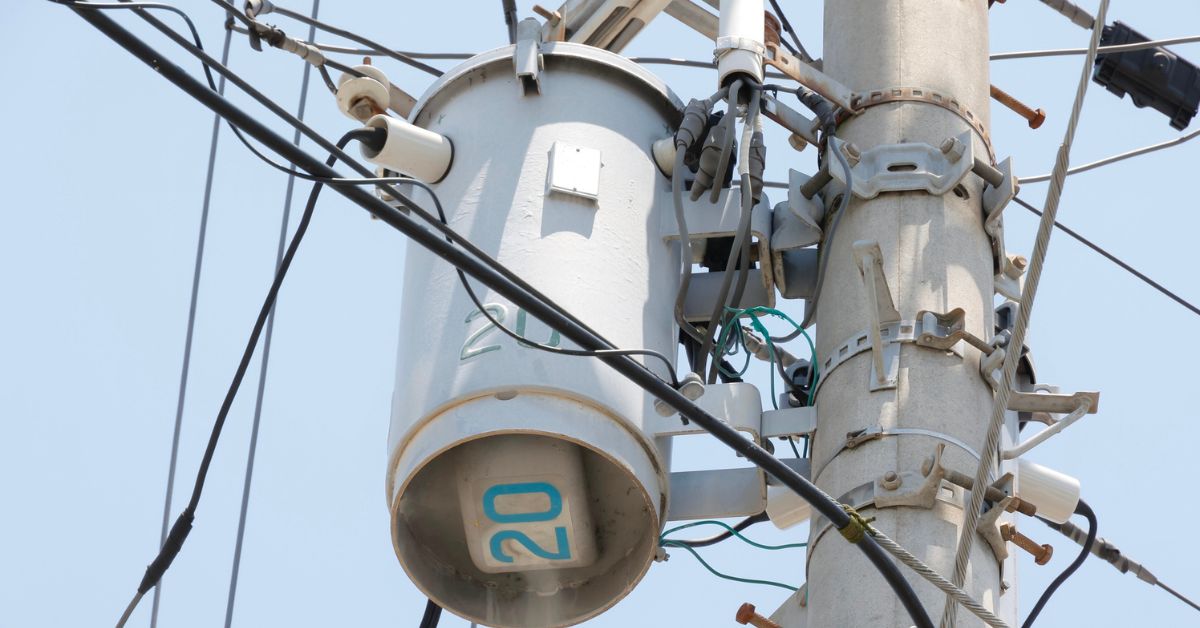
Power Line Transformer: The Gray Can That Powers America
A power line transformer steps down high voltage from distribution lines to safe levels for homes and plants.
These oil-filled cans sit on utility poles across the United States. I’ve climbed plenty in Texas heat and Midwest snow. They keep motors running and lights on without drama, until they don’t.
Table of Contents
What Is a Power Line Transformer?
It’s a pole mounted transformer (or distribution type) that takes primary voltage (7.2kV–34.5kV) and drops it to secondary like 120/240V single-phase for homes or 277/480V three-phase for factories.
No fancy parts, just coils, core, oil. Electromagnetic induction does the work. Primary winding gets high volts, creates magnetic flux in the silicon steel core, secondary picks up lower volts.
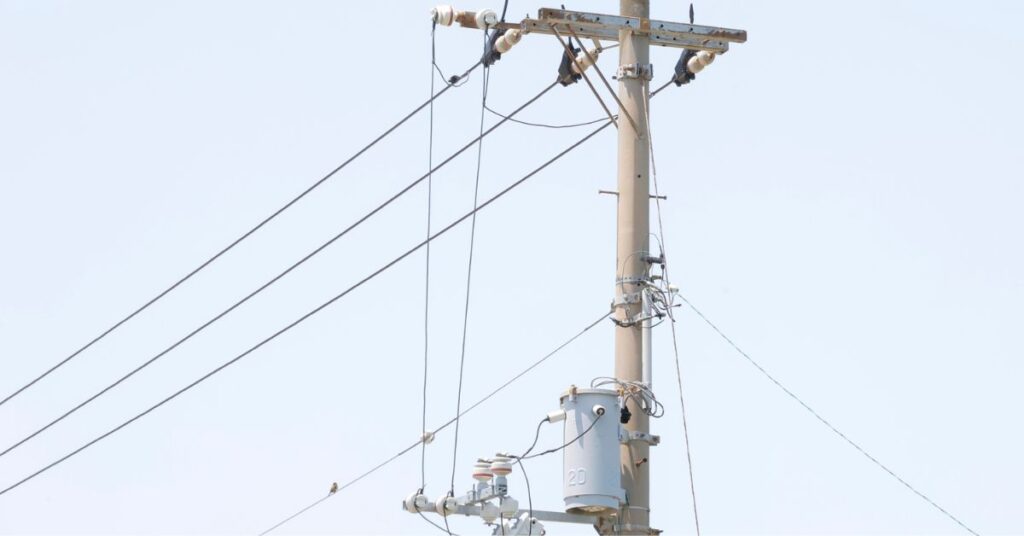
In the USA, most residential ones are overhead pole mounted transformers, cylindrical, oil-filled, bolted to poles. They handle the final step-down before service drop wires hit your meter.
How It Works in Simple Terms
AC hits the primary coil (fewer turns, high insulation). Changing the current reverses the magnetic field in the core. A secondary coil (with more turns) induces a lower voltage.
Turns ratio sets the drop. Example: 33:1 ratio on 7,200V primary gives ~218V secondary, close to 240V standard.
Oil cools windings by convection, no fans needed. It also insulates and quenches arcs. Losses turn to heat, but good oil keeps temps down.
Efficiency? 98–99% on solid units. Seen old GE ones from the ’70s still humming.
Core Components
- Core: Laminated silicon steel – cuts eddy losses.
- Windings: Copper (best) or aluminum – primary high volts, secondary low.
- Oil: Mineral – cools, insulates. The sight glass shows level.
- Bushings: Porcelain/polymer – connect cables safely.
- Tank: Holds oil, has relief valve for pressure.
- Tap changer: Adjusts voltage by ±5%.
Standard kVA Ratings and Sizes for Power Line Transformers in the USA
Residential: 10–50 kVA single-phase (feeds 1–10 homes).
Commercial/Industrial: 75–167 kVA+ (three-phase for motors/panels).
| 10–25 | Small homes/rural | 7.2–14.4 kV | 120/240V | Light load, suburbs |
| 37.5–50 | Neighborhood average | 7.2–34.5 kV | 120/240V | 5–8 homes |
| 75–100 | Apartments/small plants | 12.47–34.5 kV | 208Y/120V or 480Y/277V | Three-phase common |
| 167+ | Industrial/data centers | 13.8–34.5 kV | 480V+ | Often pad-mounted |
Oversize 20–30% for growth, EVs and heat pumps spike loads fast.
Common Failures I’ve Seen
Overload: Add ACs/EV chargers without checking kVA, unit heats, oil degrades, windings fail.
Oil leaks: Gaskets crack from age/weather, loses insulation/cooling.
Lightning/surges: Direct hits vaporize bushings despite arresters.
Animals/contact: Birds/squirrels, bridge phases: arcs.
Aging insulation: Moisture/contamination breaks down paper/oil.
Explosions are rare but real, pressure from arcing + bad relief valve.
Oil-Filled vs Dry-Type Comparison
| Cooling | Natural oil convection | Air/resin |
| Use | Outdoor poles/substations | Indoor/fire-sensitive |
| Efficiency | Higher heat dissipation | Slightly lower |
| Maintenance | Oil checks/leaks | Minimal |
| Safety | Fire risk if rupture | Safer, no oil |
| Lifespan | 25–40 years | 15–25 years |
| Cost | Lower | Higher |
Oil wins outdoors, cheaper, handles overload better.
Real-World USA Examples
- Texas Suburban Overload (2022): 50 kVA fed 12 homes with new EV chargers. Dimming lights, 112% load peaks. Swapped to 75 kVA, stable at 120V ±2V. EVs strain these hard in 2026.
- California EV Station (Bakersfield): 75 kVA units at the plaza. Night peaks sagged voltage. Diversity factor helped size right, no oversizing needed.
- Arkansas Food Plant: 112.5 kVA pad-mounted fed VFDs/conveyors. Harmonics overheated windings. Added K-rated, problem solved.
- Michigan Wastewater: 100 kVA failed after lightning (carbon track on the bushing). Replaced with polymer bushing, higher BIL rating, no repeat.
Troubleshooting & Safety for Power Line Transformer
Assume you energized, 7kV doesn’t forgive mistakes.
Checklist:
- No secondary volts? Check the primary fuse/hot stick test.
- Low volts under load? Overload/loose neutral.
- Loud buzz? Core loose/overload –>IR scan.
- Oil leak? Gaskets/corrosion –> shut down/report.
- Flicker on motor start? Undersized –>recalc inrush.
Safety:
- FR clothing, insulated gloves/tools.
- 10 ft clearance min.
- Buddy system, never alone.
- Lockout/tagout before work.
- Watch backfeed (solar/generators).
IR camera spots hot spots early $200 tool saves thousands.
Best Practices to Extend Life
- Size with 20–30% margin, growth is inevitable.
- Annual IR scans/torque lugs.
- Oil samples/DGA every 2–3 years, catch arcing early.
- Surge arresters on primary.
- Clean bushings, salt/dust causes corona.
- Ground tank/neutral per NEC, <25Ω resistance.
Loose lugs cause 80% heat faults, check yearly.
distribution transformerRead the full guide: Distribution Transformer – How It WorksWhy They Matter in 2026
Power line transformers bridge the high voltages grid to usable power. No them, no safe motors, panels, PLCs.
Shortages brutal: Lead times 24–48 months, prices up 30–80% (copper/steel). EVs, data centers, and renewables have pushed demand 34–119% higher since 2019. Utilities scramble, delays hit reliability.
Respect the can. Ground right, keep cool, don’t overload, it lasts 30–50 years.
I’ve wired panels fed by these for decades. Treat them right, no drama.
Q1: What is the power line transformer?
A power line transformer is that big gray can you see bolted to a utility pole or sitting on a pad. It takes high voltage from the overhead lines usually 7,200 to 35,000 volt and drops it down to something safe and usable, like 120/240V for homes or 277/480V for shops and plants. Electromagnetic induction does all the work, no moving parts, just coils and a core. Honestly, it’s the last big step before power hits your meter. Most are oil-filled with primary and secondary windings wrapped around silicon steel. Without these, safe distribution across the USA would be a nightmare.
Q2: What do transformers on power lines do?
They step the voltage way down so it’s safe for homes, offices, factories. Without them you’re looking at thousands of volts straight to your outlets, appliances toast, wiring fried, people shocked. They also keep the utility’s high side isolated from your gear, so faults don’t travel. Seen it go wrong too many times. Basic stuff, but it keeps the grid solid and safe.
Q3: How does a power line transformer work?
Alternating current flows through the primary winding and creates magnetic field in the metal core. That field cuts through the secondary winding and induces a lower voltage. The turns ratio sets how much it drops, for example, 1,000 turns primary to 30 secondary on 7,200V gives you roughly 240V. Oil keeps everything cool and insulated in most units. Simple physics, no fancy stuff. I’ve watched this principle keep factories running for decades.
Q4: What’s inside a power line transformer?
You’ve got a laminated silicon steel core to guide the magnetic field, copper (or sometimes aluminum) windings for primary and secondary coils, mineral oil for cooling and insulation, porcelain or polymer bushings on top for connections, a tap changer to tweak voltage a bit, and a tank with fins or radiators. There’s a pressure relief valve too, if things get hot inside, it vents gas before the tank blows. All these pieces work together to drop high primary voltage to low secondary safely. Seen plenty of these opened up, same guts every time.
Q5: Why these transformers on power poles?
Cheap overhead line poles protect transformers from floods, kids, and vandals. Crews can travel easily with bucket trucks. This method is best for rural and suburban homes and light commercial buildings’ final voltage drop. For speed and cost, pole mounting is better on most US streets than pad-mounted in underground or city areas.
Q6: What is a pole mounted transformer?
It’s a distribution transformer strapped right to a utility pole, cylindrical, usually oil-filled, rated 10 to 167 kVA or higher. The primary side takes 7,200V, 13,800V, or similar; the secondary provides 120/240V single-phase for homes or 277/480V three-phase for commercial. Feeds from 1 house to a bunch, depending on the load. You see these metal cans everywhere, quietly keeping neighborhoods lit up day in, day out.
Q7: What is the difference between pole mounted and pad mounted transformers?
Pole mounted sit high on poles, they are cheaper to install, are easy for bucket truck crews, and are perfect for overhead lines and residential streets. Pad mounted sit on ground pads, feed underground cables, look cleaner in subdivisions or commercial areas, but cost more and can flood or get smacked by cars. Guts are similar, windings, oil or dry-type, but pole wins in rural/suburban spots for speed and cost; pad-mounted takes over in cities and new builds.
Q8: How much does a power pole transformer cost normally?
A 25–50 kVA single-phase oil-filled one runs cost $1,500 to $4,000 just for the unit. Throw in crew labor, a bucket truck, and pole prep, and the total installed cost landing about $2,500 to $7,000. Bigger three-phase or special dry-types push past $10,000. Prices shot up 30–50% since 2020 due to shortages. Utilities own them, homeowners don’t pay upfront, rates cover it. Lead times and costs are still brutal in 2024–2026.
Q9: What are power line transformer sizes and kVA ratings?
For homes, pole mounted often runs 10, 15, 25, 37.5, 50, 75, or 100 kVA. small ones cover 1 to 5 houses, mid-size take 6–15, or light commercial. 3-phase supply for industries or offices go 75, 112.5, 150, 225, 300 and 500 kVA. Size depends on load, diversity, and future growth. Utilities add 20–30% extra to prevent overload and burning the windings. Overload one, and it dies quickly.
Q10: What are the common voltages are used in power line transformers (primary & secondary side)?
the Primary side in residential area is about 7,200V OR 7,620V line-to-neutral (12,470V or 13,200V line-to-line in wye connection), up to 13,800V for heavier feeders. Secondary is almost always 120/240V split-phase for homes, 120V leg-to-neutral for outlets, 240V leg-to-leg for big loads. Commercial and industrial run 208/120V or 277/480V three-phase. Matches NEC and appliance needs. The transformer makes that jump safe.
Q11: Why do power line transformers use oil?
Mineral oil insulates like crazy and pulls heat away from windings and core. It stops arcing, keeps moisture out, and lets heat rise to the tank fins for air cooling. Oil-filled units last longer outdoors and withstand overload better than dry-type units. Some spots ban oil for fire risk, but for pole-mounted across the USA, it’s still the reliable, cheap choice.
Q12: What causes a power line transformer to fail or explode?
Overload degrades insulation, lightning punches through even with arresters, oil gets low or dirty and loses strength, short circuits make internal arcs, age breaks down the paper and oil. Heat boils the oil, pressure builds, if the relief valve jams, the tank rips open. I’ve seen them let go with a bang after overload arcing. Maintenance, load monitoring, and good surge protection stop most failures.
Q13: How to troubleshoot a faulty power line transformer?
Assume it’s hot, and test the primary voltage with a hot stick or a non-contact tester first. Check the cutout fuse; if it is blown, trace why. Measure secondary, if nothing with good primary, likely open winding or internal issue. Check first for visual inspection, for leaks, burnt smell, bulging, loud hum. Thermal camera catches hot spots quickly. For deep diagnosis, de-energize, ground, megger insulation, and check the turns ratio. Bad ones usually get swapped; repairs on oil-filled aren’t worth it. Lockout/tagout and PPE every step.
Q14: Are power line transformers step-up or step-down?
Step down, almost every time, on poles. They drop high primary side voltages (7,200V, 13,800V) to low secondary voltages (120/240V or 277/480V) for homes and industries. Step-up is for generators or wind farms to send power far. But the one feeding your street? Always stepping down so you get safe power at the meter.
Q15: What is the importance a power line transformer in the electrical grid?
It’s the final bridge. it takes high-voltage distribution and delivers low, safe voltage to customers. High voltage travels long distances efficiently, then drops locally. Also isolates faults so utility problems don’t reach your gear. Distribution transformers are the “last mile” from generation to substations, feeders, pole-mounted units, and then to your meter. Grid falls apart without them.
Q16: How are power line transformers installed on utility poles?
Crew brings a bucket truck or climber, full PPE, coordinates with dispatch to kill power if possible. Crane or winch lifts it up, bolts or straps it to the pole. Primary hooks to lines via bushings and fused cutout; secondary feeds service drop to meters. Tank bonds and grounds per NEC, neutral grounded at transformer and entrance. Check voltage, three-phase phasing, and torque everything. It’s a high-risk job, and only trained line workers can do it with power line transformer.
What safety precautions should electricians take while working power line transformers?
Lets say its energized, test with a hot stick or a non-contact. Protect using Full arc-rated gear: class 2+ rubber gloves, FR clothing, hard hat, glasses. Lockout/tagout before any work. Never solo. 2 ft min distance for 7.2 kV unless protected. Watch backfeed from solar or generators. Look for leaks, cracked bushings, smoke, buzzing, oil on the ground, evacuate, and call the utility fast. High voltage doesn’t give second chances.
