
Voltage Drop Calculator — The Simple Guide Every Electrician and Homeowner Needs
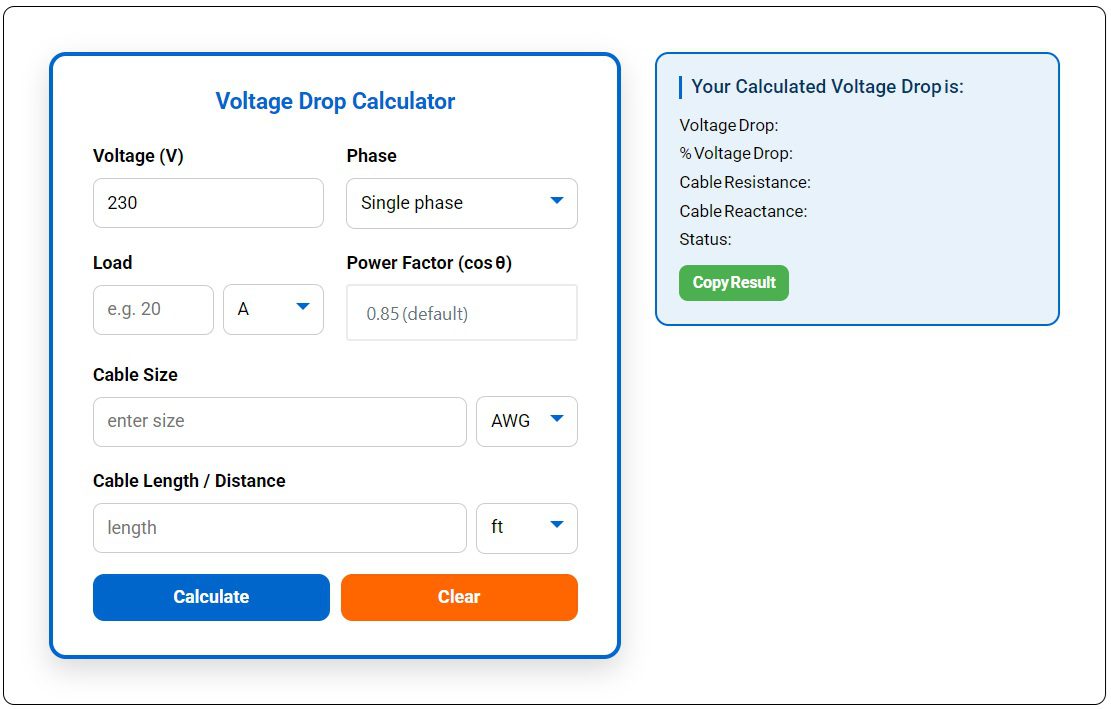
Voltage Drop Calculator
Your Calculated Voltage Drop is:
% Voltage Drop:
Cable Resistance:
Cable Reactance:
Status:
Let’s be real — nothing’s more frustrating than finishing up a new circuit, flipping the switch, and realizing your lights dim halfway down the line. That, my friend, is voltage drop biting you. When current moves through a wire, some voltage naturally gets lost because of resistance. It’s normal, but if it’s too high, things don’t run right — motors overheat, lights fade, and you waste energy.
I’ve been working around electrical setups my whole life, and voltage drop calculations are one of those things people keep overlooking until it costs them time or equipment. So let’s break it down in plain English, walk through how to handle it, and use a voltage drop calculator the right way.
This guide covers real‑world applications, simple formulas, and tips I’ve picked up over the years. By the end, you’ll know exactly how to size a wire, check a run, and keep your systems running smooth.
- Every wire has resistance — longer runs mean greater voltage drop.
- Voltage Drop = Current × Resistance (Ohm’s Law).
- Keep branch‑circuit drop ≤ 3 % and total drop ≤ 5 % per NEC guidelines.
- Excessive drop can cause dimming lights and overheating motors.
What Is Voltage Drop?
Every wire has resistance. When current flows, that resistance eats up a bit of voltage. The longer the wire or the more current you push, the bigger the loss. That loss is the “voltage drop.”
In simple terms:
Voltage Drop = Current (I) × Resistance (R)
You can use Ohm’s Law if you want to double‑check:
V = I × R
If your run is long or your wire too small, voltage drops more than the recommended limits set by the National Electrical Code (NEC). NEC generally says that branch circuits shouldn’t drop more than 3%, and the total circuit shouldn’t lose more than 5%. Go higher, and you’ll start seeing performance issues.
Why a Voltage Drop Calculator Matters
Sure, you can crunch numbers on paper, but a good online voltage drop calculator saves a ton of time. It automatically factors in wire gauge, conductor type (copper or aluminum), distance, current, and voltage.
It tells you exactly:
- How much voltage you’re losing ?
- What percentage that loss is ?
- What wire size you should use to fix it?
If you’ve ever wondered why your 12‑gauge wire struggles with a 100‑foot run, the calculator gives you that “aha” moment in seconds.
Real‑Life Example: Home Workshop Setup
When I built my small garage workshop, I ran a 240‑V line for my air compressor. Total distance was about 120 feet round‑trip. At 20 amps, my meter showed a noticeable drop. After checking with a wire size calculator, I saw I needed to step up from 12‑gauge to 10‑gauge copper to stay under a 3% voltage drop. The fix cost me about $45 in wire but saved my compressor from early burnout.
Key Factors That Affect Voltage Drop
| Factor | Description | Real‑World Impact |
|---|---|---|
| Wire Material | Copper vs. Aluminum | Copper conducts better — less drop for same size. |
| Distance | Length of the run | Longer distances increase resistance. |
| Amperage | Load current | Higher current = higher voltage drop. |
| Wire Size (AWG) | Wire diameter | Bigger wire = lower resistance. |
| Voltage Type | AC or DC | DC suffer more from voltage drop over the same run. |
The Basic Voltage Drop Formula
Here’s the practical formula most electricians use:
Voltage Drop (Vd) = (2 × K × I × L) / CM
Where:
K = Resistivity factor (12.9 for copper, 21.2 for aluminum)
I = Current in amps
L = Length of wire (one way, in feet)
CM = Circular mil area of the wire
If you want to find voltage drop percentage, divide the drop by the source voltage and multiply by 100.
Typical Voltage Drop Limits
| Circuit Type | Recommended Drop | Maximum Total Drop |
|---|---|---|
| Branch Circuit | 3% | 5% |
| Feeder Circuit | 2% | 5% |
| Low‑Voltage Lighting | 5%–10% depending on lamp type | — |
Keep your total under 5% and you’re golden — it’s enough to keep devices safe and energy costs light.
Copper vs. Aluminum — Quick Comparison
| Feature | Copper Wire | Aluminum Wire |
|---|---|---|
| Conductivity | High | Medium |
| Cost | Higher | Cheaper |
| Weight | Heavier | Lighter |
| Size Needed | Smaller | Larger for same load |
| Typical Use | Residential, precision work | Long‑run feeders, large installs |
If you’re wiring a home or shop, copper wins most of the time. For long industrial feeders where cost dominates, aluminum makes sense — just remember anti‑oxidant compound and correct termination.
How to Reduce Voltage Drop in Your Circuits
Here are a few tricks I’ve picked up over the years:
- Go up one wire size if your run is more than 75 feet.
- Use copper over aluminum when possible.
- Keep the run short — move the load closer if you can.
- Balance loads between circuits.
- Double‑check terminals for tight connections — loose ones raise resistance fast.
Practical Example: Solar System Wiring
A buddy of mine set up a 24‑V solar battery bank. He used 10‑gauge wire for a 35‑amp inverter 60 feet away. The drop was huge — about 7%. After running the numbers through a solar wire size calculator, he upgraded to 6‑gauge. Drop fell to 2%, and the inverter’s efficiency jumped instantly.
Moral of the story: don’t guess — calculate.
Recommended Tools and References
If you’re serious about getting voltage‑drop calculations right, explore these trusted resources. They combine industrial accuracy with clear, real‑world guidance.
Featured Resource:
Main Reference:
Additional Resources:
Extra Tip: Field Voltage Drop Test
You can actually test drop directly if you’re curious — grab a meter. Measure voltage at the source, then at the load under full current. The difference is your real drop. If it’s more than 5% of your nominal voltage, your wire or distance needs adjustment.
Real‑World Case Studies
- Construction Site Setup: A temporary power pole feeding a saw table 150 feet away dropped 10 V on startup. Upgrading from 10‑gauge to 8‑gauge fixed it instantly.
- Small Office Wiring: A copier line showed burnout signs. Voltage drop tested at 7 %. They re‑routed to a closer panel — problem gone.
- Boat Wiring: DC circuits on boats lose voltage faster. Switching to tinned marine wire improved lighting by 12 %.
Quick Reference Table: Voltage Drop per Amp and Foot for Copper (Estimate)
| AWG | Ohms per 1000 ft | Approx Drop (Volts per 10A @100ft) |
|---|---|---|
| 14 | 2.53 | 2.53 |
| 12 | 1.59 | 1.59 |
| 10 | 0.999 | 1.0 |
| 8 | 0.628 | 0.63 |
| 6 | 0.395 | 0.40 |
| 4 | 0.248 | 0.25 |
Keep this chart handy before each new wiring run.
Detailed FAQ on Voltage Drop Calculations
Q1: What exactly is voltage drop, and why should I care about it?
Ans: Voltage drop is the amount of voltage that’s lost as current flows through a conductor due to electrical resistance. Think of it like water pressure fading along a long hose — the longer or thinner it is, the weaker the flow. Too much drop means devices don’t receive full voltage, leading to dim lights, sluggish motors, or equipment stress.
Q2: How much voltage drop is acceptable according to the NEC or general practice?
Ans: The National Electrical Code (NEC) recommends a maximum of 3% voltage drop on any single branch circuit and 5% total for the combined feeder and branch circuit. While this isn’t a hard legal requirement, most professional electricians treat it as a golden rule because it ensures safe, efficient operation. In large industrial settings, designers sometimes apply even tighter targets—around 2%—for sensitive automation controls.
Q3: What factors influence how much voltage drop occurs?
Ans: The major factors are wire length, wire gauge, material (copper vs. aluminum), and current load. Longer runs and smaller wires generate more resistance, which means higher drop. High current flow increases the load on the wire, compounding the loss. Temperature also affects resistance—hotter environments mean higher resistance and higher voltage drop.
Q4: How do I measure voltage drop with a meter in real conditions?
Ans: It’s simple: run the load, measure voltage at the power source, then at the farthest point of the load. Subtract the two readings—the difference is your voltage drop. If it’s over 5% of your supply voltage, your wire may be undersized or your run too long.
Q5: Can I reduce voltage drop without replacing the wire?
Ans: Sometimes yes. Start by checking joints, terminals, and breakers for corrosion or loose connections. Tightening a few screws can make a big difference. If multiple loads share the same circuit, split them across breakers. Lower current draw by balancing or staggering loads can also help. But if the issue is small wire or long distance, upgrading size is the permanent fix.
Q6: How do copper and aluminum wires compare when it comes to voltage drop?
Ans: Copper conducts roughly 40% better than aluminum. That means aluminum must be one or two sizes thicker to match performance. Copper costs more but offers better conductivity and connection reliability. Aluminum is cheaper and lighter—good for long feeders when cost matters.
Q7: Does alternating current (AC) behave differently from direct current (DC) in terms of voltage drop?
Ans: Yes. DC suffers more from voltage drop on long runs because there’s no alternating waveform to average resistance effects. AC circuits add reactance, but for short 60 Hz runs it’s minimal. For low‑voltage DC (like solar or battery), use thicker cables or shorter lengths.
Q8: How do I calculate voltage drop manually if I don’t have a calculator?
Ans: Use Vd = (2 × K × I × L) / CM, where K = 12.9 for copper, 21.2 for aluminum, I = amps, L = length (feet one way), CM = circular mil area. Then %Vd = (Vd / Voltage) × 100. If it exceeds 3% on a branch circuit, redo the setup.
Q9: Why do electricians often upsize wire beyond code minimums?
Ans: Code is the bare minimum. Field conditions vary and loads fluctuate; upsizing reduces resistance, keeps voltage stable, and extends equipment life. The extra copper cost is tiny compared to downtime or damage from undervoltage.
Q10: How far can I run a 120‑volt line before voltage drop becomes a problem?
Ans: Roughly 50 feet on 14‑AWG for 15 A keeps drop =< 3%. Double distance and the drop doubles. For longer runs use 12‑ or 10‑AWG.
Q11: What happens if I ignore voltage drop?
Ans: Lighting dims, motors overheat, breakers trip, and electronics misbehave. In industry, undervoltage can fault drives and stop production.
Q12: What’s a common mistake people make with long circuits?
Ans: Forgetting the return path: count distance both ways. Extension cords add more length—and more drop.
Q13: Can low‑voltage systems handle higher drops?
Ans: They can tolerate 5‑10%, but because supply is small, even 1 V loss in 12 V is ≈8%. So design thicker or shorter runs for 12–24 V systems.
Q14: How does temperature impact voltage drop?
Ans: Heat raises resistance. In hot areas above 100 °F, upsize one AWG. NEC Annex B shows correction tables.
Q15: How do I calculate voltage drop for three‑phase systems?
Ans: Use the same logic but multiply by √3 instead of 2 in the formula. Many use dedicated 3‑phase calculators for speed.
Q16: How does wire length influence cost and design?
Ans: Designers compare larger‑wire cost versus energy loss. Over time, bigger wire saves money through efficiency and cooler operation.
Q17: What’s the best way to plan for voltage drop before construction?
Ans: Use calculators during design. Mark distances, major loads, and potential feeders. Preventing drop on paper is far cheaper than re‑pulling wire later.
Q18: How is voltage drop handled in solar or battery installations?
Ans: DC systems typically target 2‑3% drop. Use large copper cables, short runs, and solid busbars; small improvements greatly increase charging efficiency.
Q19: What tools do professionals use to verify voltage drop?
Ans: Digital multimeters, clamp meters, power‑quality loggers, or smart recorders that show voltage under load.
Q20: Why should every electrician keep a voltage drop chart nearby?
Ans: Because no one memorizes wire resistance values—charts save time and prevent undersizing errors on job sites.
Q21: What’s the difference between percentage voltage drop and absolute drop?
Ans: Absolute drop is in volts (like 5 V out of 120). Percentage drop is relative (5 ÷ 120 = 4.17%). Percentage lets you compare systems of different voltages.
Q22: What’s the consequence of voltage drop on motor performance?
Ans: A 10% voltage drop can cut motor torque ≈20%. Results: slow starts, stalling, overheating, and faults on 3‑phase motors from unbalance.
Q23: Are there software tools for advanced voltage drop analysis?
Ans: Yes — ETAP, SKM Power Tools, EasyPower, and AutoCAD Electrical simulate complex circuits including load diversity and harmonics.
Q24: What’s a quick field workaround when voltage drop can’t be avoided?
Ans: Use booster transformers for AC or higher transmission voltages with local step‑downs. For DC, move power closer or increase conductor size.
Q25: Where can I find detailed professional guidance?
Ans: Visit Industrial Control Academy for courses and calculators. Also check Southwire, Fluke, and Electrical‑Technology.org for charts and examples.