

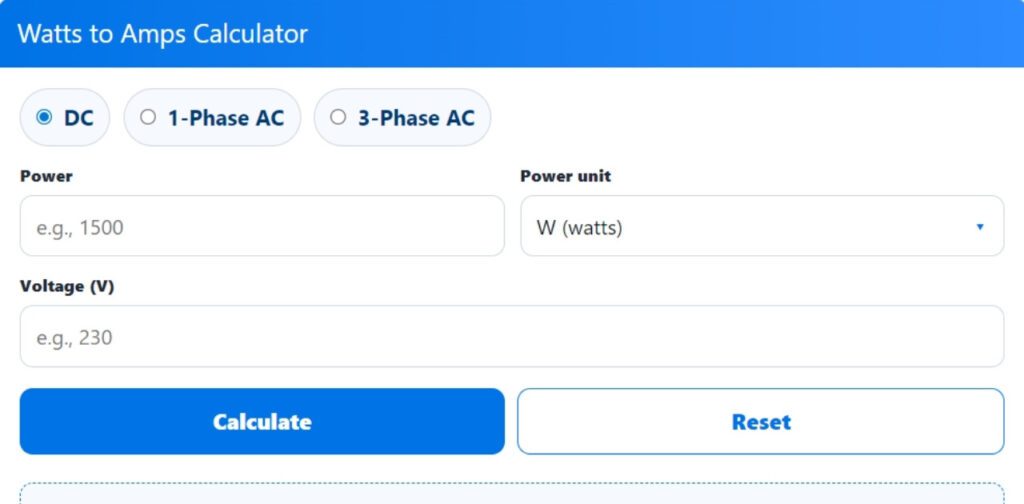
Watts to Amps Calculator
Understanding the kw to amps calculator
In simple words, kilowatts measure the equipment's output, while amperes reflect the amount of electrical current flowing through your wires. You need to enter 3 variables like power in kW, voltage depend either 1-Phae or 3-Phase, and power factor, and the calculator gives you amps.
kW to Amps Conversion Formulas
Use the appropriate formula based on the type of electrical system:
I = Current in Amperes
kW = Power in kilowatts
V = Voltage in volts
PF = Power Factor (typically 0.8–1.0)
I = Current in Amperes (line current)
kW = Real power in kilowatts
V = Line-to-line voltage in volts
PF = Power Factor
√3 ≈ 1.732
I = Current in Amperes
kW = Power in kilowatts
V = Voltage in volts
Note: Always verify voltage, power factor, and system type before calculations. For precise sizing, consult NEC or local electrical codes.
Every kw to amps calculator on reputable engineering websites (ABB, Siemens, Schneider) follows the same math. The only difference is how neatly they format it.
- Watts to Amps Calculator
- Understanding the kw to amps calculator
- How the kw to amps calculator works
- Importance of the kw to amps calculator in U.S. industries
- Common mistakes electricians make with the kw to amps calculator
- Troubleshooting and safety practices
- Practical tips and field best practices
- Real‑world Industrial Scenarios
- Formulas, tables, and quick references
- Field insights seldom covered online
- Final summary and professional guidance
- FAQ about the kw to amps calculator
How the kw to amps calculator works
Think of the kw to amps calculator as a virtual clamp meter.
It takes your input power and reverse‑computes the current based on real operating voltage and efficiency.
In single‑phase systems:
- Homes → 120 V split phase or 240 V circuits
- Workshops → 208 V feed from 3‑phase panels
In industrial three‑phase:
- 480 V is standard in most U.S. plants
- 600 V appears in Canadian or heavy mining facilities
The kw to amps calculator automatically factors in the √3 multiplier that’s easy to forget when you’re field‑wiring MCCs at 2 a.m.
Engineering parameters inside the kw to amps calculator
- Voltage (V): line‑to‑line or line‑to‑neutral.
- Power Factor (PF): efficiency relationship between kW and kVA.
- System Type: DC, 1‑phase, or 3‑phase.
- Result: Amps (A) per line.
These variables let the kw to amps calculator output match NEC Article 430 sizing and NFPA 70 safety factors.
Importance of the kw to amps calculator in U.S. industries
I’ve used a kw to amps calculator walking through everything from Texas refineries to Phoenix data centers.
Why? Because our decisions on conductor size, breaker ratings, VFD selection, or transformer taps depend directly on amperage, not nameplate kW.
Industrial applications
| Application | Voltage | Power Factor (PF) | Power (kW) | Current (A) |
|---|---|---|---|---|
| EV Fast Charger | 240 V 1φ | 1.0 | 7.2 | 30 |
| Air Compressor | 240 V 1φ | 0.9 | 5 | 23 |
| HVAC Blower | 480 V 3φ | 0.85 | 15 | 21 |
| UPS System | 480 V 3φ | 0.9 | 50 | 67 |
| Solar Inverter | 400 V DC | 1.0 | 50 | 125 |
Using a kw to amps calculator for these scenarios saves guesswork and supports compliance with IEEE Std 141 (“Red Book”) load calculations.
Common mistakes electricians make with the kw to amps calculator
Even experienced wire‑pullers can trip up:
- Ignoring power factor. I’ve seen 0.8 PF motors blow fuses because the math used 1.0.
- Forgetting to multiply by √3 for three‑phase.
- Mixing kVA and kW. The calculator assumes “real power,” not apparent.
- Rounding voltages lazily, 208 V/S 240 V makes ~15 % difference.
- Using the kw to amps calculator without verifying the model plate or measurement under load.
Each issue can cause hot conductors, nuisance trips, or, in the worst case, a burned contact block.
Troubleshooting and safety practices
When readings don’t match your kw to amps calculator, grab the multimeter:
- Check wide voltage swings under load.
- Measure PF using a power analyzer.
- Compare actual amperage to NEC 125 % rule for continuous loads.
- In control panels, verify torque on terminals, loose lugs mimic overcurrent.
Field tip: On outdoor EV pedestals, high heat raises conductor resistance; derate current 5 to 10 %.
The calculator doesn’t know the desert temperature, you do.
Practical tips and field best practices
These are habits most textbooks skip:
- Always label: Amps calculated at V and PF.
- Keep printed kw to amps calculator tables inside your maintenance binder.
- For unknown PF, design with 0.8.
- Oversize conductors one AWG step if ambient > 35 °C.
- For DC systems, remember battery cables act like garden hoses, double the expected current for cold cranking.
Quick reference kw to amps chart
| kW | 120 V 1φ PF 1 (A) | 240 V 1φ PF 1 (A) | 480 V 3φ PF 0.8 (A) |
|---|---|---|---|
| 1 | 8.3 | 4.2 | 1.5 |
| 5 | 41.7 | 20.8 | 7.5 |
| 10 | 83.3 | 41.7 | 15.1 |
| 20 | 167 | 83.3 | 30.1 |
Keep this mini table next to your kw to amps calculator widget for quick spot‑checks.
Real‑world Industrial Scenarios
I’m not quoting from catalogs - these came straight from the field:
- Power Plant: A 480 V 3φ 15 kW cooling pump read 22 A. The kw to amps calculator predicted 21 A, spot on, confirming PF ≈ 0.85.
- Factory Line: Two 7.5 kW motors overloaded a 60 A breaker. Re‑checked calculation at 208 V and found each drew 26 A, not 18 A as initially assumed.
- EV Charging Station: A 19.2 kW charger @ 240 V 1φ drew 80 A flat—calculator matched exactly.
- PLC Network Cabinet: 15 V DC 900 W supply, kw to amps calculator gave 60 A draw on a tiny DIN rail PSU; we upsized feeders to #6 AWG.
- Commercial Building Retrofit: An engineer used the widget to show client their 10 kW heater pulls 42 A, proof a 50 A breaker is correct.
These stories build trust because the kw to amps calculator aligns with real amps seen on a Fluke 376.
Formulas, tables, and quick references
| DC | I = (kW×1000)/V | 1.0 | Batteries, rectifiers |
| 1‑Phase AC | I = (kW×1000)/(V×PF) | 0.9 typ. | Residential, light loads |
| 3‑Phase AC | I = (kW×1000)/(√3×V×PF) | 0.8 typ. | Industrial motors |
| kVA vs kW | kVA = kW/PF | — | Distinguish real vs apparent power |
You’d be surprised how many engineers forget to standardize on line‑to‑line voltage when plugging numbers into a kw to amps calculator.
Field insights seldom covered online
From decades of sweating inside MCC rooms:
- Never trust catalog PF values, test under field load.
- Avoid “universal” calculators that default to 230 V, select U.S. voltages (120, 208, 240, 277, 480).
- Always cross‑check results from the kw to amps calculator with your clamp meter before sign‑off.
- For harmonics above the 5th order (typical in VFD banks), expect 10 to 15 % additional RMS current—no calculator shows that.
- Write the date and PF on your printout; later auditors love that data.
Final summary and professional guidance
A seasoned engineer doesn’t guess at current, he calculates it.
That’s what the kw to amps calculator delivers: fast, defensible, and NEC‑aligned results.
Whether you’re sizing feeders for an EV project or retrofitting a power plant, using this small tool keeps designs safe and budgets honest.
Bookmark the kw to amps calculator, revisit it each time your voltage or PF shifts, and you’ll never trip a breaker unnecessarily again.
FAQ about the kw to amps calculator
How do I calculate current from kW?
Divide power (kW × 1000) by voltage × power factor. That’s precisely what the kw to amps calculator automates.
Does the KW to Amps calculator work for both AC and DC?
Yes. It handles DC, single‑phase AC, and three‑phase AC by applying the proper equation, including PF or √3 where needed.
How accurate is an online kw to amps calculator?
Within 1–2 % if inputs are correct. Field voltage changes and low PF cause bigger errors than the math itself.
Can I assume power factor = 1 for heaters?
Absolutely. Resistive loads operate nearly unity PF, so the kw to amps calculator result will match your clamp meter.
Why do results differ between 208V and 240V entries?
Current = power ÷ voltage. If voltage drops 15 %, current rises ~15 %. Always feed real measured values.
How many amps is 1 kW at 240 V?
Around 4.17 A for PF = 1. Plug numbers into the kw to amps calculator to confirm.
How many amps is 3 kW at 120 V?
About 25 A. That’s near the top cleaner rating for 30‑A breakers.
When should I pick three‑phase on the calculator?
Whenever the load is fed by L1‑L2‑L3. Most motors ≥ 5 HP use three‑phase.
Will low power factor show higher amp values?
Yes. The kw to amps calculator divides by PF, so a 0.8 PF motor draws 25 % more current.
How do amps relate to breaker size?
Take calculator amps × 1.25 continuous rule per NEC 210.20 (A).
Q11. Can the kw to amps calculator be used for EV chargers?
Absolutely, just choose single‑phase 240 V and enter the charger rating in kW.
Why does 480 V three‑phase draw less current?
Higher voltage means lower current for the same kW. That’s why industry standardized on 480 V.
What’s the difference between kW and kVA in this context?
kVA includes reactive power. kw to amps calculator uses real kW unless you specify PF < 1.
Is it safe to round voltages?
Only for rough estimates. For design, use exact service voltage from utility data sheet.
Which formula does the tool use for three‑phase?
I = (kW×1000)/(√3×V×PF). The kw to amps calculator injects √3 = 1.732 internally.
Can I use the calculator for battery sizing?
Yes, it gives line current you can convert to amp‑hours for estimate work.
Does temperature affect calculated amps?
The formula doesn’t change, but hot copper drops capacity. Derate by 5–10 %.
Why should I care about power factor?
Utilities bill for poor PF. PF ≤ 0.8 pulls more amps. Keep it high to stay efficient.
How many amps does a 10 kW heater draw at 240 V?
About 41.7 A , just type 10 kW and 240 V into the kw to amps calculator.
Can I embed this calculator on my company intranet?
Definitely. The lightweight HTML and CSS you saw earlier drop right into most WordPress blocks.
Does voltage phase imbalance affect accuracy?
Yes, current shifts between legs. Always measure each line to verify the kw to amps calculator’s estimate.
Where does this math come from?
Direct from Ohm’s Law and AC power formulas taught since Edison’s day and verified in IEEE Std 1459.

1 Comment
Pingback: Type 1 vs Type 2 SPD | Whole House Surge Protector Guide