

The Real Difference Between Neutral and Ground: What Every U.S. Engineer Should Know
Every electrical panel in the U.S. from a home breaker box to a 13.8 kV MCC in a refinery has a white wire and a green one. They look harmless, but mixing them up can fry equipment or hurt people. The difference between neutral and ground isn’t just theory; it decides whether a short trips a breaker or sends voltage through a steel conduit.
- The Real Difference Between Neutral and Ground: What Every U.S. Engineer Should Know
- What Are Neutral and Ground Wires?
- How the Neutral Wire Works in Real U.S. Circuits
- Ground Wire-The Silent Safety Soldier
- Where Are the Neutral and Ground on an Electrical Panel?
- Can Neutral and Ground Be Connected Together?
- Common Grounding and Neutral Mistakes in U.S. Facilities
- Troubleshooting Voltage Between Neutral and Ground
- Industrial Scenarios That Prove the Difference between neutral and ground
- Practical Tips & Best Practices for U.S. Electricians
- Importance and Applications Across Modern Industries
- Final Thoughts – What Experience Teaches About Neutral and Ground
- Conclusion
- FAQs – Common Questions for Neutral and Ground
- Are neutral and ground the same thing?
- What is the difference between neutral and ground in 3‑phase systems?
- Will the neutral wire carry current?
- Can I connect ground and neutral together?
- What happens if I switch neutral and ground?
- Will I get a shock if I touch a neutral wire?
- What is another name for the neutral wire?
- What happens if neutral touches ground?
- Do ground rods replace the neutral?
- What if the neutral carries too much current?
- How to tell if ground or neutral is broken?
- What is another name for the ground wire?
- Why do I measure a small voltage between neutral and ground?
- Should there be continuity between neutral and ground?
- What is the purpose of ground wire?
- What is the purpose of neutral wire?
- Which wire is safe to touch?
- How can I tell between neutral and ground wire?
- What happens if neutral is not grounded?
- What are common grounding mistakes?
What Are Neutral and Ground Wires?
In simple terms, the neutral wire is the current’s return path. The ground wire is a safety escape path for fault current. They meet at a single point, the main service bonding jumper. Everywhere else, they must stay apart.
- Neutral (white or gray): Carries load current back to the source.
- Ground (green or bare): Sits idle until something fails.
- Hot (black or red): Pushes current out from the source.
When everything is healthy, the ground should have zero amps. When things go wrong, a cracked motor winding or a nicked cable, the ground provides a low‑resistance path for the fault so protective devices trip quickly.

How the Neutral Wire Works in Real U.S. Circuits
I’ve seen 480/277 V lighting systems where the neutral quietly balances uneven phases all day. A 120 V control panel lets PLC power supplies see the other side of the circuit. Without a neutral, half your lights wouldn’t turn on, and current would look for any sneaky path it could find, usually metal conduit or grounding conductors. That’s when breakers start acting strange.
Key points engineers remind new techs:
- Neutral always connects to the system’s grounded point, usually the transformer’s secondary center tap.
- It carries current continuously, treat it as live.
- Loose neutrals cause voltage fluctuation and noisy electronics.
Ground Wire-The Silent Safety Soldier
The ground conductor doesn’t care about normal current flow. It sits ready to carry fault current only during abnormal events. When a motor coil shorts to the frame, the ground protects you from touching 480 V through a wrench handle.
A quick story: in a fertilizer plant’s MCC, one drive cabinet showed 40 V between chassis and true ground. A rusted bonding lug kept the fault path open. The breaker never tripped until someone touched the door. A simple continuity test caught it later. That’s why proper grounding and bonding is the quiet hero of industrial safety.
Table 1: Practical Comparison Between Neutral and Ground
| Feature / Function | Neutral Wire | Ground Wire |
| Purpose | Carries return (load) current in normal operation | Provides fault‑current path for safety |
| When it carries current | Always, whenever circuit is energized | Only during a fault or surge |
| Color (USA) | White or gray | Green or bare copper |
| Connection point | Tied to grounded transformer terminal and main neutral bar | Bonded to equipment chassis and earth electrode |
| Protective role | Prevents voltage imbalance | Prevents shock and ensures breaker trips |
| Separation rule | Isolated from ground except at main service | Must never share bar in subpanel |
| Typical conductor size | Same gauge as phase | Often smaller but per NEC 250 sizing |
| Voltage to earth under normal load | Small (0–2 V) | 0 V except during fault |
Where Are the Neutral and Ground on an Electrical Panel?
Open a main service panel in the U.S., and you’ll see two metal bars mounted to the back.
- The neutral bar has white wires and is bonded to the enclosure by a screw or strap.
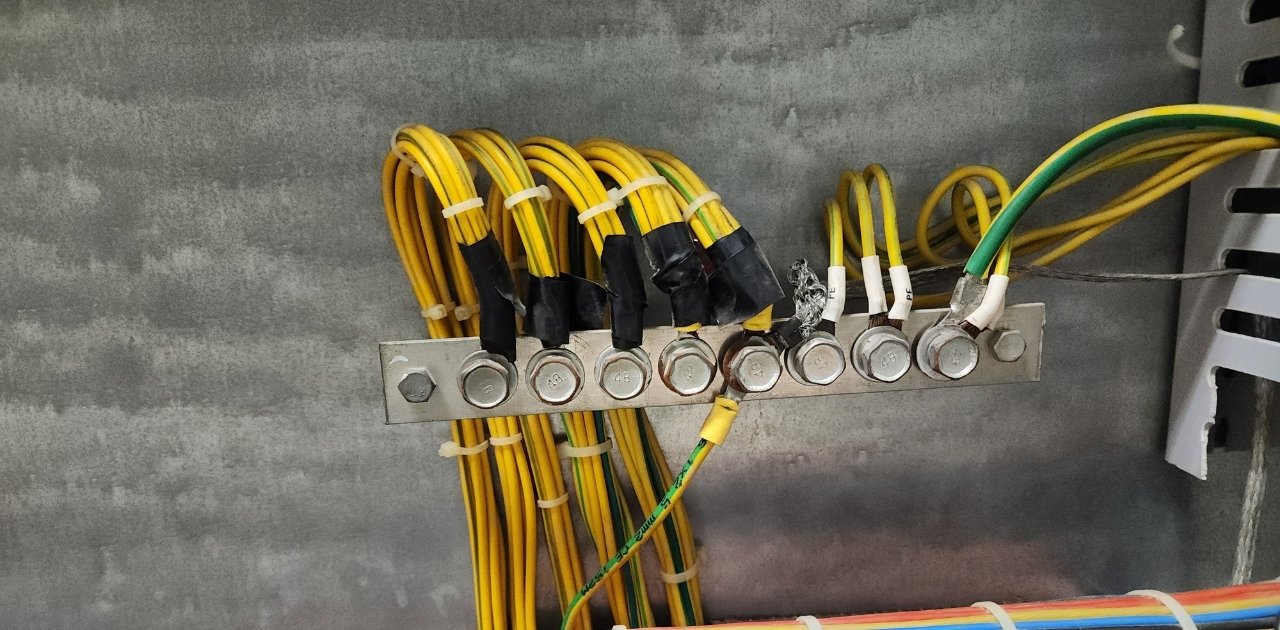
- The ground bar carries green or bare conductors, which are also connected to the steel cabinet and the earth rod.
In subpanels, that bonding strap must be removed, keeping neutral isolated. If you tie them together downstream, stray current flows on the conduit, and you’ll spend hours chasing phantom voltage readings. always keep the neutral and ground separate.
Can Neutral and Ground Be Connected Together?
You can, but only once, at the main service disconnect. Nowhere else.
The reason: the neutral already links back to the transformer’s grounded point, and the ground links the system to earth for fault protection. If you reconnect them in the downstream cabinet, the current divides: half runs on the white wire, and half runs through raceways and structural steel. That’s a silent safety nightmare waiting to happen.
Quick field rule:
“Bond once, bond right at the first means of disconnect.”
Every NEC update keeps that principle alive because it works. Make sure neutral and ground are not connectec together.
NFPA – Grounding and Bonding Basics (NEC Reference)Common Grounding and Neutral Mistakes in U.S. Facilities
After fifty years walking job sites, I’ve seen the same blunders repeat, from small machine shops to huge gas turbines.
1. Neutral and ground tied in subpanels
Every few months, I still open a subpanel where someone thought “extra bonding helps.” No, it creates parallel return paths. You’ll measure current on metal conduits and touch voltage on pump frames.
2. Missing or corroded bonds
At power plants in coastal states, corrosion eats ground lugs first. When a fault hits, resistance skyrockets, breakers delay, and arcs get violent.
3. Shared neutral on multi‑wire circuits without simultaneous disconnects
Two single‑pole breakers sharing one neutral? That’s how you roast insulation when one pole trips. Always use a common trip or a two‑pole breaker.
4. Floating neutrals in generators
Portable sets feeding panels through transfer switches need a clear neutral bonding configuration – bonded at the generator or service, not both.
Troubleshooting Voltage Between Neutral and Ground
When you measure 1 – 3 V AC between neutral and ground, don’t panic. A small voltage is normal because the neutral carries load current through the wiring resistance.
Trouble starts when it’s higher than about 5 V or fluctuates wildly.
Step‑by‑Step Check:
- Measure at the outlet – note neutral‑to‑ground voltage.
- Measure right at the panel – compare values.
- If the drop disappears near the source, the branch neutral has high resistance (loose screw, corroded lug).
- Inspect bonding jumper and ground electrode; open joints cause backfeed voltage.
Field tip: Use a true RMS meter and measure both the voltage and the milliamperage difference. A good enclosure should never carry a steady current.
Table 2: Neutral to Ground Voltage Interpretation
| Reading (Volts AC) | Likely Condition | Recommended Action |
| 0 – 2 V | Normal loaded circuit | No issue |
| 2 – 5 V | Long run or undersized neutral | Check conductor size / load balance |
| 5 – 15 V | Loose or corroded neutral | Tighten and clean terminations |
| >15 V | Dangerous potential / improper bonding | De‑energize and trace return path |
Industrial Scenarios That Prove the Difference between neutral and ground
Example 1 – Fertilizer Plant MCC
A 480 V motor tripped randomly. Neutral to ground voltage showed 11 V on the control transformer secondary. Cause? Neutral is tied to the same bar as equipment ground in a subpanel. The fix was simple, separate the bars and re‑bond only at the main gear. Trip issues vanished.
Example 2 – Hospital PLC Cabinet
Technicians chased nuisance analog noise for weeks. Analyzer found 2 A flowing on shield drain wires. The panel neutral and ground shared the same screw. Separation restored 16‑bit accuracy instantly.
Example 3 – EV Charging Station
Installers bonded the sub‑distributor incorrectly. A loose neutral created backfeed over the charger’s communication line. The EV wouldn’t handshake with the network until the neutral bar was isolated per NEC 625.
Example 4 – Standby Generator
A contractor left both neutral bonds intact, one in the generator, one in the main service. With ATS on open‑transition, that double bond sent a circulating current through the grounding conductor. The generator frame kept 18 V potential to earth until corrected.
Example 5 – Old House Panel
An owner complained of a “tingle” in the sink. Neutral and ground on the same bar in a feeder panel caused a small current in the copper plumbing. Once isolated, the shocks disappeared.
H2: Key Comparison of Panels – Main vs Subpanel Bonding
| Parameter | Main Panel | Subpanel |
| Neutral–Ground Bond | Yes, single connection point | No, keep isolated |
| Neutral Bar | Bonded to enclosure | Floating on insulation spacer |
| Ground Bar | Bonded to enclosure | Bonded to enclosure |
| Purpose | Return + fault current reference | Distribute derived circuit safely |
| Typical Plug Boards | Service entrance, main disconnect | Remote MCCs, machine controls |
Practical Tips & Best Practices for U.S. Electricians
- Always color‑identify wires: white = neutral, green/bare = ground.
- Verify that the bonding jumper only exists at the service. Remove it in subpanels.
- When in doubt, megger test the insulation and check for continuity between ground bars.
- Neutral current = sum of unbalanced phase currents; plan conductor size accordingly.
- Keep the control system shields isolated from the power ground unless specified.
- Document every panel’s bonding configuration for maintenance teams.
- Follow NEC Article 250, your best friend when inspectors arrive.
Importance and Applications Across Modern Industries
- Power plants: ground grids protect turbines, and neutral grounding resistors limit fault current.
- Chemical units: stray voltage can spur corrosion; separated neutrals avoid that.
- EV stations: fast chargers rely on clean ground references for safety self‑tests.
- PLC networks: analog input precision depends on noise‑free grounding.
- Home and commercial buildings: Correct neutral and ground separation reduces nuisance GFIs.
Engineers often underestimate how much getting this tiny detail right affects equipment reliability.
Final Thoughts – What Experience Teaches About Neutral and Ground
After half a century tracing circuits through Factory, Mills and substations, my advice is simple:
treat the neutral like the current’s highway, and the ground like its guardrail.
They run side by side but serve completely different missions. When you keep them separate everywhere except the main service point, your gear runs cooler, breakers behave, and no one gets that nerve‑rattling buzz off a motor frame.
If you ever face weird voltage readings or random control trips, start with the basics: check your bonding, check your neutrals, and remember that a few ohms of corrosion can cost a week of downtime.
Table 3: Quick Bonding Checklist for Field Engineers
| Check Item | Acceptable Condition | Comment |
| Neutral–ground bond location | One only at main service | Remove any extra straps downstream |
| Ground electrode resistance | < 25 Ω to earth | Use clamp‑on tester; record annually |
| Neutral bar insulation | Fully isolated in subpanels | No metallic contact to cabinet |
| Conduit continuity | < 0.1 Ω end‑to‑end | Ensures reliable equipment ground |
| Voltage N–G (loaded) | < 5 V AC | Higher → inspect loose neutral |
| Labeling colors | White/gray = neutral, green/bare = ground | Consistent plant‑wide |
Paste this table right inside your maintenance binder, it cuts troubleshooting time in half.
H2: Optional Conversion Table – Wire Gauge vs Load Current (Handy Neutral Sizing)
| AWG Size | Copper Ampacity (75 °C) | Common Circuit Example |
| 14 AWG | 15 A | Lighting / controls |
| 12 AWG | 20 A | Receptacle circuits |
| 10 AWG | 30 A | HVAC compressor |
| 8 AWG | 50 A | Motor feeders |
| 6 AWG | 65 A | Subpanel feed |
| 4 AWG | 85 A | MCC feeder |
| 2 AWG | 115 A | Transformer secondary |
Conclusion
The divide between neutral and ground is small in the panel but massive in importance.
When you wire with discipline, single bond at service, isolated neutrals elsewhere, you prevent circulation currents, shocks, and fire hazards. These fundamentals haven’t changed since the NEC’s earliest editions because physics hasn’t changed either.
Keep your panels clean, torque verified, and labeling consistent. That’s the difference between electrical work that merely functions and systems that stay safe for decades.
FAQs – Common Questions for Neutral and Ground
Are neutral and ground the same thing?
No. The neutral carries load current, while the ground carries current only during a fault. They serve separate purposes and connect only at the main service.
What is the difference between neutral and ground in 3‑phase systems?
The neutral is the common return for unbalanced phase currents; the ground stabilizes the system to earth and provides a fault path.
Will the neutral wire carry current?
Yes, whenever any load is operating. Many people assume it’s “safe,” but it can be at full line current under imbalance.
Can I connect ground and neutral together?
Only once, at the first service disconnect per NEC 250.6. Anywhere else violates the code and creates a shock risk.
What happens if I switch neutral and ground?
Devices may appear to work, but metal parts can become energized; breakers might not trip during a fault.
Will I get a shock if I touch a neutral wire?
Possibly yes. The neutral can be near line potential under load. Always treat it as live.
What is another name for the neutral wire?
It’s often called the “grounded conductor” in the NEC, because it’s intentionally connected to earth at one point.
What happens if neutral touches ground?
At the main panel, nothing abnormal. it’s bonded there. Anywhere else, it allows current to return through metalwork, creating shock hazards.
Do ground rods replace the neutral?
No. Rods only stabilize voltage relative to earth. They do not carry normal current or replace the neutral conductor.
What if the neutral carries too much current?
It overheats conductors and can cause fire. Balance phase loads or upsize the neutral as per NEC 220.
How to tell if ground or neutral is broken?
Check with a light tester or meter; high neutral‑ground voltage or open readings indicate a loose or missing conductor.
What is another name for the ground wire?
It’s commonly called the “equipment grounding conductor.”
Why do I measure a small voltage between neutral and ground?
Because the neutral carries current through resistance in long runs, producing a small voltage drop. It’s normal up to a few volts.
Should there be continuity between neutral and ground?
Only at the main service disconnect. Subpanels must show isolation when tested with a continuity meter.
What is the purpose of ground wire?
To provide a safe path for fault current to earth, triggering protective devices, and preventing shock.
What is the purpose of neutral wire?
To complete the return circuit between load and source, ensuring stable voltage for single‑phase devices.
Which wire is safe to touch?
None. Treat every conductor as energized until proven otherwise with proper testing equipment.
How can I tell between neutral and ground wire?
In U.S. wiring, neutral is white or gray; ground is green or bare. Always verify with a meter and continuity test.
What happens if neutral is not grounded?
The system floats, voltage can drift, and fault current won’t have a low‑resistance path, breakers may fail to trip.
What are common grounding mistakes?
Missing lugs, corroded straps, tying neutrals and grounds together downstream, and ignoring periodic torque checks.
