

kVA to Amps Calculator (120–480 V, 1 Phase and 3 Phase)
A quick and easy way to find out how many amps your gear really needs We all know what it’s like to stand in front of a new generator or transformer label and try to figure out how many amps you’ll get from a 240-volt feed when it says “25 kVA.” You don’t want to have to guess; you want maths that you can trust. This is exactly what this guide and calculator are for.
kVA to Amps Calculator
I’ve worked on electrical projects for a long time, from small shop upgrades to big commercial installations. It seems hard to change kVA to amps, but it’s not that hard once you do it. After that, it becomes second nature. You just put your numbers into a quick formula, and there you have it: the load current.
What is kVA? Let’s make it easy.
kVA, or kilovolt-ampere, is a unit of apparent power that is equal to volts times amps divided by 1,000. Amps tell you how much electricity is flowing. That tells you how big the wire should be, how strong the breaker should be, and how long your equipment will last. The efficiency part is the power factor (PF). PF is about 0.8 for most industrial loads. For loads that only resist (like heaters), have PF = 1. You don’t have to think too much about it; knowing kVA and voltage will help you find amps in no time.
Voltage Drop Calculator
Explore Industrial Control Academy’s free tool to compute real‑world voltage drop for single‑ and three‑phase circuits. Enter wire size, length, amp load, and voltage to see instant results.
Open Voltage Drop Calculator ↗Single-Phase and Three-Phase Base Formulas
These are the two equations you should use most often. Remember them in your head.
| System | Formula | Notes |
|---|---|---|
| Single‑phase | I (A) = (kVA × 1000) / V | Utilised in residences or modest retail establishments |
| Three‑phase | I (A) = (kVA × 1000) / (√3 × V) | Commercial and industrial loads |
If you have a single-phase unit with a power rating of 25 kVA and 240 V, → I = (25 × 1000)/240 = 104 A If it’s three-phase at 480 V, then I = (25 × 1000)/(1.732 × 480) ≈ 30 A. It’s easy once you put in the numbers.
Voltage Drop Calculator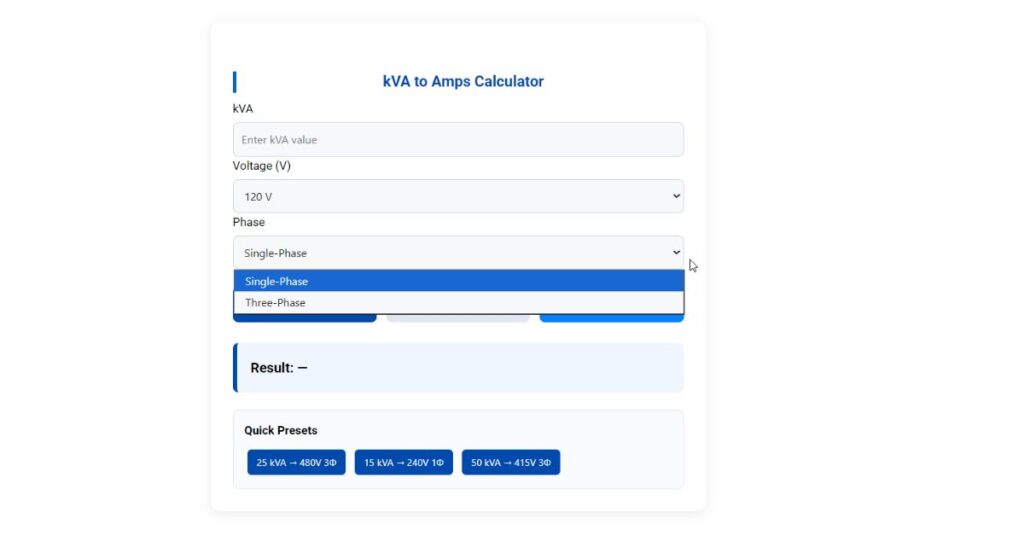
FAQ
How do I convert kVA to amps for single-phase power?
Multiply kVA by 1000 to get VA, then divide by voltage (V). Formula: I = (kVA × 1000) / V Example: 10 kVA at 240 V = (10 × 1000) / 240 = 41.67 A.
How do I convert kVA to amps for three-phase power?
Formula (line-to-line voltage): I = (kVA × 1000) / (√3 × V) √3 ≈ 1.732 Example: 50 kVA at 400 V = (50 × 1000) / (1.732 × 400) ≈ 72.17 A.
Why do we even use kVA instead of kW?
kVA measures apparent power (total power supplied, including reactive). kW measures real power (actual work done). Equipment like transformers, generators, and cables are sized by current, which depends on kVA—not kW—so kVA prevents under sizing and overheating.
What is power factor (PF), and how does it change the result?
PF = real power (kW) / apparent power (kVA), ranging from 0 to 1 (unity = no reactive power). Most motors/PF ≈ 0.8–0.9. If PF is known, actual amps = (kVA × 1000) / (V × PF) for single-phase, or adjust accordingly. Low PF means higher amps for the same kW, so ignore it and you underestimate current.
What’s the main difference between single-phase and three-phase current flow?
Single-phase: one alternating voltage waveform (one “hot” wire + neutral). Three-phase: three waveforms offset by 120°, smoother power delivery, constant power output, less vibration in motors, and ~58% less current per conductor for same power → smaller/cheaper wires.
Can I apply this same formula to generators?
Yes, generator ratings are in kVA (apparent power capacity). Use the formula to find full-load current for sizing cables, breakers, or paralleling. Always check nameplate PF if given.
What about transformers, is that same rules?
Yes, transformers are rated in kVA. Use the formula on primary or secondary side (with respective voltage) to find current. Example: 100 kVA transformer, primary 11 kV → very low amps; secondary 400 V → much higher amps.
How do I calculate amps when I know kW instead of kVA?
First convert kW to kVA: kVA = kW / PF Then use standard kVA-to-amps formula. Example: 40 kW load, PF=0.8 → kVA = 40 / 0.8 = 50 kVA → proceed as usual.
Why does the calculator sometimes show slightly different values?
Rounding (1.73 vs 1.732 for √3), voltage assumptions (e.g., 230 V vs 240 V), or ignoring small PF/efficiency differences. Real measured voltage often varies ±5–10 V.
Is there a shortcut to memorize the three-phase formula?
kVA times a thousand, divided by one-point-seven-three-two times volts. Repeat it: handles the √3 factor for balanced three-phase.
Does frequency (50 Hz vs 60 Hz) change anything?
No, the kVA-to-amps formula is independent of frequency. Frequency affects motor speed, transformer design, and inductive reactance, but not this basic current calc.
How do I convert back from amps to kVA?
Reverse: Single-phase kVA = (V × A) / 1000 Three-phase kVA = (√3 × V × A) / 1000 Example: 100 A at 480 V three-phase → kVA = (1.732 × 480 × 100) / 1000 ≈ 83.1 kVA.
How should I pick cable size once I know amperage?
Use ampacity tables (e.g., NEC Table 310.16 or IEC equivalents) based on conductor type, insulation, ambient temp, and derating. Pick the next larger standard size than calculated amps. For long runs, check voltage drop (<3–5%).
What’s the danger of ignoring power factor?
You underestimate current by 20–25% (e.g., PF=0.8 means 25% more amps than unity PF calc). This causes overheating, voltage drop, nuisance trips, and premature failure of wires/breakers.
Could I use this calculator for inverters or UPS systems?
Yes, same apparent power rules apply. Use output kVA rating for load-side current, input for charging/rectifier side. Many list both kVA and PF.
How do I read an equipment nameplate showing both kVA and amps?
Verify: Plug nameplate kVA and voltage into formula → should match listed amps (±5%). Differences usually from assumed PF (often 0.8) or rounding.
How do voltage drops affect real current in long runs?
Current remains almost constant (load dictates it). Voltage drops at the load end, so power delivered falls. Keep drop <3% (NEC recommendation) by upsizing cable.
What do “apparent,” “real,” and “reactive” power mean?
– Real power (kW): Does useful work (heat, motion).
– Reactive power (kVAR): Oscillates, needed for magnetic fields (motors/transformers), no net work.
– Apparent power (kVA): Vector sum (√(kW² + kVAR²)), determines current and sizing.
How do I use table data safely for quick checks?
Tables/charts give rounded values (common voltages/PF=1 or 0.8). Good for estimates, but always calculate exactly with site voltage/PF before final sizing or purchasing.
Why do electricians favor three-phase for large systems?
Lower current per conductor (~1/√3 or 58% of single-phase equivalent), smaller/cheaper cables, less copper, smoother power, higher efficiency, and better for large motors/pumps.
What’s the current for common generator sizes?
– 20 kVA @ 240 V single-phase ≈ 83.3 A
– 50 kVA @ 480 V three-phase ≈ 60.1 A
– 100 kVA @ 400 V three-phase ≈ 144.3 A (Using PF=1; derate slightly for real PF.)
How do I create my own calculator in Excel?
Single-phase: =(A21000)/B2 (A2=kVA, B2=volts) Three-phase: =(A21000)/(1.732*B2) Add dropdown for phase, input cells for kVA/volts/PF if needed.
Is there a difference between 230 V and 240 V in real life?
Small, usually <5% variation in utility supply. Use measured or nominal value; 240 V common in US single-phase, 230 V in many international systems. Difference adds ~4% error in amps.
Can temperature or altitude affect actual amp draw?
Formula for amps stays the same (load-based). But high temp/altitude derates conductor ampacity (less cooling) and equipment ratings, may need larger wire or reduced load.
How do I explain kVA to someone who only cares about amps?
kVA is like the total “size” of the electrical appetite; amps is the actual flow through the wires. Higher kVA means more amps needed at the same voltage like bigger pipes for more water flow.
Are there safety margins I should add?
Yes, add 20–25% headroom for starting surges (motors), future loads, and continuous duty. Size breakers/wires to next standard size above calculated amps.
Can I use these formulas for 208 V systems?
Yes, common US three-phase (208Y/120 V). Example: 30 kVA @ 208 V three-phase → I = (30 × 1000) / (1.732 × 208) ≈ 83.3 A.
What’s the best way to remember when to use √3?
Use √3 only for three-phase systems with balanced loads and line-to-line voltage. No √3 for single-phase or if using line-to-neutral in three-phase (then divide by 3 instead).
Can I trust online calculators for permit documentation?
For planning/rough checks, yes. For permits/inspections use stamped engineering calcs or official software. Inspectors want traceable math, not just web tool screenshots.
How much error is acceptable between theoretical and measured amps?
±5% is normal (voltage/PF variations). >10% → recheck PF, actual voltage, load balance, or meter accuracy.
When should I think in kVA instead of amps?
When buying/specifying generators, transformers, UPS, or switchgear—manufacturers rate them in kVA. Convert to amps only for wiring/breaker sizing.
What’s a simple sanity check for my math?
Lower voltage → higher amps (inverse relation).
Three-phase → lower amps than single-phase for same kVA/voltage.
Higher PF → lower amps for same kW. If results flip any of these, double-check inputs.
