

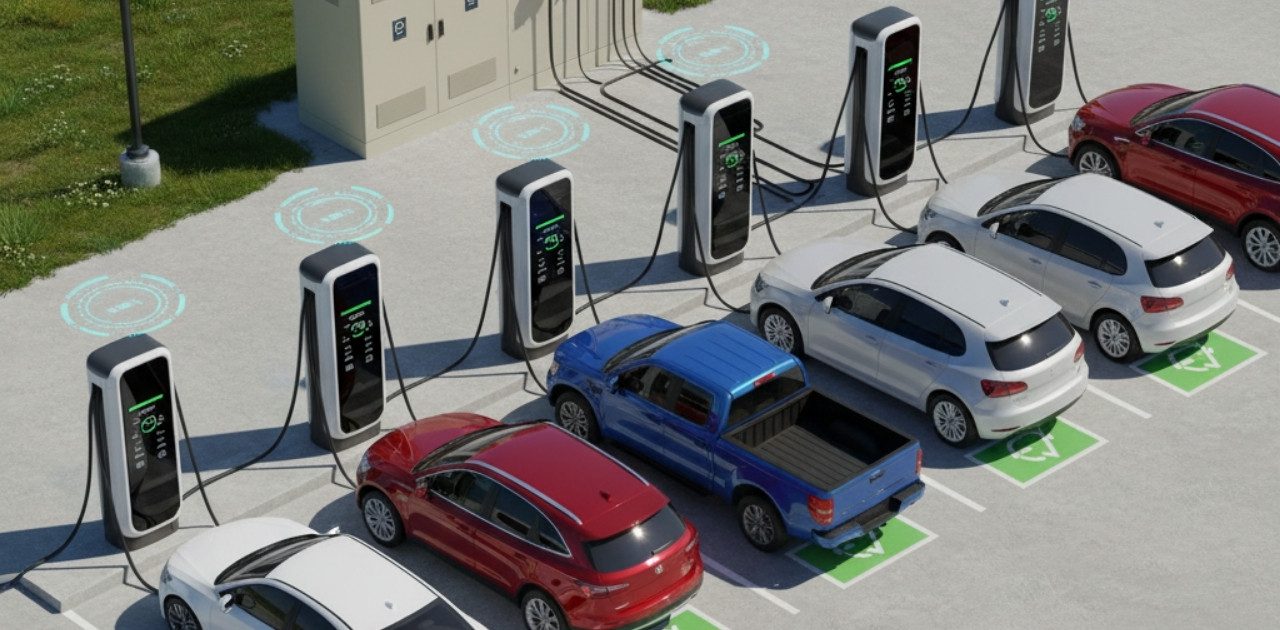
Level 1 vs level 2 ev charging confused me too when I bought my first EV back in 2019. I stood in my garage; holding the portable cord that came in the trunk, staring at a regular wall outlet, and wondering why anyone would pay a thousand bucks for a wall charger when this free cord seemed to work just fine. Forty hours later my car still was not fully charged. That answered my question pretty fast.
Now in 2026 the landscape looks different. SAE J3400 NACS has replaced the old connector mess. Most new EVs roll off the line with native J3400 ports. Electricity plans have shifted heavily toward Time-of-Use pricing. And the level 1 vs level 2 charger debate matters more than ever because batteries keep getting bigger while people keep wanting faster turnaround.
I have trained EV technicians for over twenty years and designed charging systems for homes, apartment complexes, and commercial fleets. This guide walks you through both charging levels with honest engineering numbers, 2026 costs, and the decision framework I use with my own clients. I will show you the Easy comparison table; break down real costs, and help you figure out which setup belongs in your garage.
- What Are EV Charging Levels? Quick Overview
- Level 1 vs Level 2 EV Charging -Side-by-Side Comparison (2026)
- Level 1 Charging – Everything You Need to Know
- Level 2 Charging – The Practical Choice for Most Drivers
- Cost Breakdown 2026 – Level 1 vs Level 2
- Which One Should You Choose? Decision Guide
- Smart Features and Future-Proofing (2026)
- Common Mistakes and Pro Engineer Tips
- FAQs About Level 1 vs Level 2 EV charging
- Conclusion:

Fig-1: Level 1 vs Level 2 EV charging comparison diagram showing 120 V and 240 V circuits
What Are EV Charging Levels? Quick Overview
Think of EV charger levels like water pipes. Bigger pipe, faster flow. That is basically it.
Level 1 taps into a regular 120V household outlet mainly. Your car sips electricity through a narrow straw at about 1.4 to 1.9 kW. You get maybe 3 to 5 miles of range back every hour. Good enough for a golf cart, frustrating for a modern EV.
Level 2 hooks up to a 240V dedicated circuit; same voltage your dryer uses. Power jumps to 7 through 19.2 kW depending on the unit. Range recovery shoots up to 12 to 60 miles per hour.
Level 3 is DC fast charging at public stations. We are talking 50 to 350 kW, completely different equipment, different cost structure, and not something you install at home. That deserves its own article so I will stay focused on the home charging decision here.
Level 1 vs Level 2 EV Charging -Side-by-Side Comparison (2026)
I built this table from real measurements I have taken on client installs, not from manufacturer brochures.
| Spec | Level 1 | Level 2 |
| Voltage | 120V AC | 240V AC |
| Typical amperage | 12A | 32 to 48A |
| Power delivered | 1.4 to 1.9 kW | 7 to 19.2 kW |
| Range added per hour | 3 to 5 miles | 12 to 60 miles |
| Hours to charge 60 kWh pack | 35 to 45 | 5 to 8 |
| Hours to charge 100 kWh pack | 55 to 72 | 8 to 14 |
| Equipment cost | $0 (comes with car) | $400 to $900 |
| Installation cost (2026) | $0 | $500 to $2,000 |
| Connector (2026) | J1772 adapter or J3400 | J3400 NACS native |
| Dedicated circuit needed | No | Yes |
The basic charging time formula I teach my technicians:
Hours = (Charger kW × 0.88) / Battery kWh
That 0.88 factor accounts for real charging efficiency losses. The onboard charger generates heat, the battery management system takes a cut, and cold weather makes things worse. I have measured efficiency anywhere from 84% to 92% across different vehicles and temperatures.
Level 1 Charging – Everything You Need to Know
Level 1 charging is dead simple. Pull the portable EVSE cord out of your trunk, plug it into any standard 120V outlet, and walk away – The car draws about 12 amps and puts roughly 1.4 kW into the battery.
That sounds fine until you do the math. A 60 kWh battery takes over 40 hours from empty. Nobody charges from truly empty of course. Most people coming home with 50 to 70 percent remaining. But even replacing 20 kWh takes about 14 hours on Level 1. That is a tight overnight window and it does not leave room for error.
I have a client in suburban Ohio who drove 22 miles round trip to work. She used Level 1 for two years and it worked perfectly for her. Plug in at 6 PM, car was ready by 6 AM, she never thought about it. But when she changed jobs and her commute jumped to 55 miles, Level 1 could not keep pace anymore. She would lose ground every day and end up at 15% by Friday afternoon. That is when she called me.
Level 1 charging speed runs 3 to 5 miles per hour in mild weather. In January in Minnesota I have measured it drop closer to 2.5 miles per hour because the battery heater runs off the same trickle of power.
Pros of Level 1:
- Costs absolutely nothing, the cord comes free with your EV
- No electrician, no permit, no panel work
- Works at any 120V outlet in the country
- Only draws 12 amps so it plays nice with existing circuits
- Great backup even if you install Level 2 later
Cons of Level 1:
- Brutally slow for BEVs with batteries over 40 kWh
- Cannot recover more than 40 to 50 miles overnight
- Cold weather tanks the already slow speed
- Not viable for daily driving over 35 to 40 miles
- You feel range anxiety not from the car but from the charger
Can I use level 1 charger every day? Absolutely- but only if your daily driving stays under 35 miles and you have 10 or more hours to charge every night. PHEVs with batteries under 20 kWh are the sweet spot for Level 1.
Level 2 Charging – The Practical Choice for Most Drivers
This is where owning an EV starts feeling like owning a cell phone just like Plug in at night, wake up full, never think about gas stations again.
A level 2 home ev charger runs on a 240V dedicated circuit Like; Most home units pull 32 to 48 amps, That delivering 7.7 to 11.5 kW. How much faster is level 2 than level 1? In my real world testing, about five to seven times faster depending on the specific setup. A 48-amp unit charging at 11.5 kW recovers almost 30 miles of range every hour_ The level 1 vs level 2 charging speed difference feels like going from dial-up internet to broadband. Same data, completely different experience.
I recently installed a unit for a family with two EVs in Portland. One car had a 7 kW onboard charger, the other had an 11.5 kW onboard charger & Same Level 2 wall unit, but the second car charged almost twice as fast because the onboard charger could accept more power. This is a detail people miss. Your charging speed is limited by whichever is smaller: the wall unit’s output or the car’s onboard charger rating.
You get two installation options. Plug-in units connect to a NEMA 14-50 outlet and you can unplug them if you move. Hardwired units connect directly to the circuit wiring and generally support higher amperage. I tell renters to go plug-in and homeowners to go hardwired.
The connector situation has gotten much simpler in 2026. SAE J3400 NACS is now standard on practically every new EV sold in North America. Level 2 chargers ship with J3400 cables. If you have an older car with J1772 you just grab a $15 adapter and you are set.
Pros of Level 2:
- Charges any EV fully overnight without breaking a sweat
- Smart EV charger models schedule around Time-of-Use rates automatically
- App control lets you monitor energy use and set charging limits
- Adds genuine resale value to your home
- Handles 100 plus mile daily driving without stress
Cons of Level 2:
- Requires professional installation and a dedicated 240V circuit
- Permits and inspections are mandatory in most jurisdictions
- Upfront cost between $900 and $2,500 all in
- Older homes may need a panel upgrade to fit the new breaker
Cost Breakdown 2026 – Level 1 vs Level 2
Let me lay out what you are actually spending and saving. I pulled these numbers from installs I quoted and completed in 2025 and early 2026.
| Cost Item | Level 1 | Level 2 |
| Charger unit | $0 | $400 to $900 |
| Installation labor | $0 | $500 to $1,500 |
| Panel upgrade (if needed) | N/A | $800 to $2,000 |
| Permit and inspection | N/A | $75 to $200 |
| Typical total | $0 | $900 to $2,500 |
The level 2 ev charger installation cost in 2026 average around $1,200 for a standard garage install where the panel sits within 25 feet. My most expensive residential install this year hit $3,800 because we had to trench conduit 60 feet to a detached garage and upgrade a 100amp panel to 200amps.

For electricity cost I keep it simple and calculate per mile. Every EV I have metered in my shop pulls about 0.30 kWh per mile give or take. Where I live the utility charges $0.16 per kWh so that shakes out to roughly five cents a mile. People who at normally charge late at night on Time-of-Use plans pay closer to $0.08 per kWh which brings it down to about two and a half cents per mile. But; gasoline sitting at $3.50 a gallon in a car getting 30 miles per gallon costs you nearly twelve cents for every mile driven.
Annual savings on 12,000 miles:
Gas Cost: (12,000 ÷ 30) × $3.50 = $1,400
EV Cost (Off-Peak): 12,000 × $0.025 = $300
Annual Savings: $1,100
A $1,200 Level 2 install pays itself back in about 13 months. Is level 2 charging worth it? The math says yes for anyone keeping their home more than two years.
The IRA federal tax credit under Section 30C still covers 30% of equipment and installation, capped at $1,000 for residential. Many utilities stack additional rebates of $200 to $500 on top. Check your utility website before hiring an electrician because some programs require pre-approval.
Which One Should You Choose? Decision Guide
I keep this simple for my clients. Three questions settle it.
Question 1: How distant do you drive average on a daily? Multiply your commute by 1.3 to account for errands and weekends trips. Under 35 miles adjusted, Level 1 handles it. Over 40 miles, you require Level 2. Between 35 and 40 is a gray zone where Level 1 works in summer; but may have to struggling in winter.
Question 2: What kind of EV do you drive? PHEV batteries are little, typically 10 to 18 kWh. Level 1 charges them fully overnight without issue. BEVs with 60 to 100 kWh batteries absolutely need Level 2 for daily use unless you drive very little.
Question three: Do you own or rent? Renters usually cannot install dedicated 240V circuits. Level 1 or a portable Level 2 with a NEMA 14-50 plug (if a dryer outlet is accessible) are your options. Homeowners should install Level 2 and treat it like any other home improvement.
Smart Features and Future-Proofing (2026)
The level 1 vs level 2 ev charger gap goes beyond raw speed. Modern Level 2 units are genuinely smart devices.
Bidirectional charging through V2H lets your car power your house during outages. Several 2026 Level 2 chargers support this when paired with compatible vehicles. Your 80 kWh car battery becomes a whole-home backup generator that can run critical loads for two days.
Load management features automatically throttle charging when your AC or dryer kicks on just Like preventing breaker trips without you touching anything. App control Just lets you schedule sessions, track costs per kWh, and integrate with rooftop solar production.
I installed a smart charger for a client last month that automatically shifts all charging to a two-hour window between 1 AM and 3 AM when her utility rate drops to $0.06 per kWh. She saves about $35 monthly compared to charging at peak rates. Over ten years that is $4,200 from a software feature.
Common Mistakes and Pro Engineer Tips
I fix these problems constantly. Please do not repeat them.
Undersized wiring. For 40-amp circuits just using 8 AWG copper minimum. For 50-amp or runs over 50 feet use 6 AWG. I found 10 AWG on a 40-amp charger circuit last month. The wire was warm to the touch. That is a fire waiting to happen.
Sharing circuits with other stuff. Your Level 2 charger needs its own dedicated circuit. Do not tap into the dryer line, the oven circuit, or anything else. NEC requires this and common sense demands it.
Skipping permits. An unpermitted install can void your homeowner’s insurance and torpedo a home sale. Budget $100 to $200 for the permit. It protects you.
Ignoring panel capacity. A 48 amp charger on a 60 amp breaker takes a serious bite from a 200 amp board. Add up your existing loads first. I have walked into homes where the panel was already at 85% capacity before anyone mentioned adding a charger.
No GFCI protection. NEC Article 625 requires it for EV charging equipment. Most quality units have it built in. Cheap ones sometimes do not. Verify before buying.
FAQs About Level 1 vs Level 2 EV charging
How much faster is level 2 than level 1?
In real conditions level 2 charges about five to seven times faster. Level 1 adds 3 to 5 miles per hour while a 40-amp Level 2 setup adds 25 to 30 miles per hour. I have tested this across a dozen different vehicles and the ratio stays consistent. The exact speed depends on your onboard charger ratings and the ambient temperatures but you can count on that at least a 5x improvement.
What does level 2 ev charger installation cost in 2026?
In my opinion, it cost for $900 to $2,500 total including the unit and labor. A straightforward garage install with a nearby panel typically runs about $1,200. Panel upgrades, long conduit runs, or trenching to detached structures push costs higher. Federal IRA credits cover 30% up to $1,000 and many utility rebates knock off another $200 to $500.
Can I use level 1 charger every day?
Definitely, as long as your daily driving stays under 35 miles and you have 10 plus hours each night to charge. PHEVs work great on Level 1 daily. BEV owners who try this with longer commutes slowly drain their battery through the week and end up scrambling for a public charger by Friday.
Is level 2 charging worth it?
For BEV owners the answer is almost always yes. The $1,200 average install cost pays back in about 13 months through fuel savings compared to gasoline. Beyond money you get the convenience of a full battery every single morning. I have never had a client regret installing Level 2 but I have had many regret waiting.
What connector do 2026 Level 2 chargers use?
SAE J3400 NACS is now standard across North America.& Nearly every new EV sold in 2025 and 2026 has a native J3400 port. New Level 2 home chargers come with J3400 cables. Older J1772 vehicles work fine with a simple adapter that costs about $15.
Does Level 2 raise my electric bill a lot?
Expect $30 to $50 per month for typical driving of 12,000 miles annually at average rates. Shifting to off-peak Time-of-Use charging can cut that roughly in half. Either way it is dramatically cheaper than gasoline. My own electric bill went up $38 per month when I switched from gas to EV and my old gas budget was $160 monthly.
Do I need a panel upgrade for Level 2?
Not necessarily. Most 200 amp boards handle a 40 or 48 amp charger without issues & the Homes with 100 or 125-amp panels often need upgrades, especially if they already run electric heat, a range, and central air. A load calculation takes an electrician about 30 minutes and gives you a definitive answer.
What is the best wire size for a Level 2 install?
Just Use 8 AWG copper for 40-amp circuits and 6 AWG for 50-amp circuits or runs exceeding 50 feet; Becuase Undersized wire causes voltage drop which slows charging and generates heat. I always oversize by one gauge on long runs because the extra copper cost is trivial compared to a callback.
Conclusion:
The level 1 vs level 2 ev charging decision boils down to how much you drive and how much patience you have. Level 1 costs nothing and works for light daily use. Level 2 costs about $1,200 after tax credits, pays for itself in just over a year, and makes EV ownership genuinely effortless.
If you are buying a new EV in 2026, budget for Level 2 from day one. Get a load calculation on your board, pull the permit, and hire someone who has done EVSE installations before. Your future , the one who wakes up to a full battery every morning without ever visiting a gas station, will be grateful you did.
Circuit Breaker Troubleshooting Guide ABB EV Charging Solutions